Prince of Persia
1992 · Mindscape · Platform · 1 player
Nintendo NES
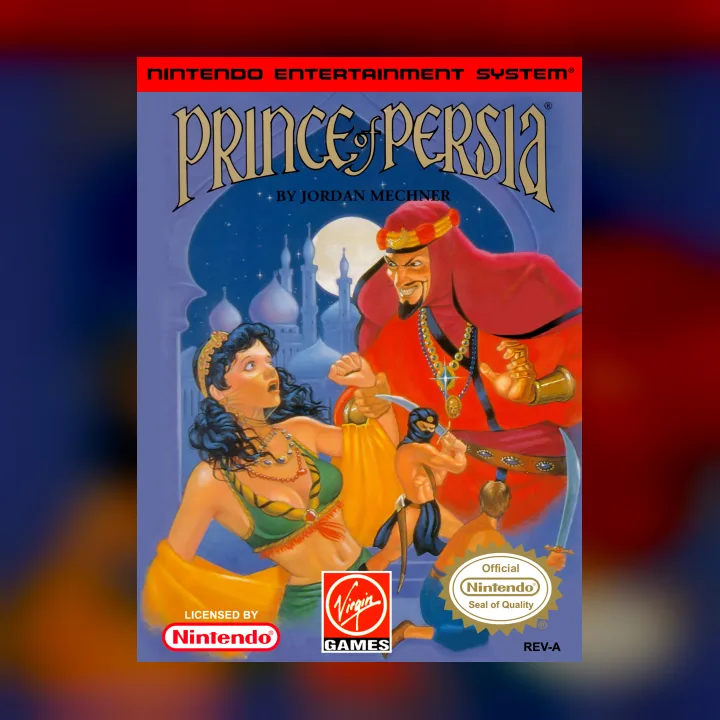
One hour, a dungeon full of spikes, pits and gates, and a vizier who wants the throne. The NES conversion of Jordan Mechner’s 1989 classic keeps the fluid running, leaping and sword fighting, and adds passwords that store your remaining time.
The 1992 Nintendo NES game, free to play in your browser.
Runs in your browser, fullscreen. Keyboard, gamepad and touch controls. Your progress is saved on this device.
About Prince of Persia
Sixty minutes to save the princess
While the Sultan is away at war, his Grand Vizier Jaffar seizes power and locks the Sultan’s daughter in a tower. The hero, a nameless young man thrown into the palace dungeons, must find his way out, climb to the tower and face Jaffar before that time runs out.
The clock never stops. On the NES, dying sends you back to the beginning of the current level, but the minutes you lost stay lost, so every careless fall costs real time. Pressing Select shows how much is left, and the counter also appears now and then at the bottom of the screen.
Careful steps, deadly floors
Prince of Persia rewards patience over speed. The hero can run, jump, hang from ledges and pull himself up, but he needs a moment to stop, and that momentum is what sends many careless players into a pit. On the NES, the B button lets him tiptoe one small step at a time, which is the safest way to line up a jump at the edge of a gap.
The dungeons are full of traps: beds of spikes, deep pits, guillotine-style blades and iron gates that have to be passed while they are open. A short drop costs a point of health, but a long fall, spikes or a blade usually ends the life outright, however healthy you are.
Swords and potions
Health is shown as a row of small triangles, three at the start. Jaffar’s sword-wielding guards block the way, and each sword hit removes one triangle from either fighter; on the NES the A button strikes and B parries. Waiting for an opening and then answering a blocked blow is far safer than attacking blindly.
Potions are scattered through the levels. Small red ones restore a point of health, but some look almost the same and take one away instead. A rarer potion fills the bar and adds an extra triangle for good. After every level the game gives you an eight-digit password that stores both the level and the time you have left.
From Apple II to NES
Jordan Mechner began work on Prince of Persia in 1985, and Broderbund released it for the Apple II on 3 October 1989. To make the hero move like a real person, Mechner filmed his younger brother David running and jumping, then traced the footage frame by frame; the sword fights were based on a duel from the film The Adventures of Robin Hood. The original has twelve levels and was soon converted to many home computers and consoles.
The NES version was developed by MotiveTime, a subsidiary of Elite Systems. Virgin Games published it in North America in November 1992, and Mindscape brought it to Europe on 29 April 1993. Mark Cooksey adapted Francis Mechner’s music to the NES sound chip and a few tracks appear to be his own compositions. This page runs the European cartridge.
Tips for the dungeon
Before a jump, walk to the edge with careful steps instead of running, then use a standing leap or a short run-up. Keep a button held as you reach a ledge so the hero grabs it rather than dropping past, and look for a safer route before taking any long fall.
Treat every guard as a duel: block, then strike back. Do not drink a potion you are unsure of when your health is low, and write down each password as soon as it appears, since it also records how many minutes remain.
Sources: en.wikipedia.org, vgmpf.com, vgchartz.com, takeontheneslibrary.com, questicle.net
Screenshots
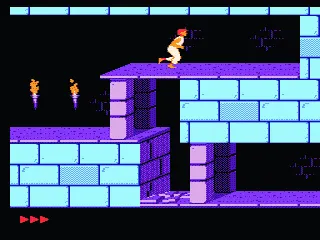
Game details
- Platform
- Nintendo NES
- Released
- 1992
- Developer
- MotiveTime
- Publisher
- Mindscape
- Genre
- Platform
- Players
- 1 player
- Original release
- 3 October 1989 (Apple II, Broderbund)
- Creator
- Jordan Mechner
- NES developer
- MotiveTime (Elite Systems)
- North America release
- November 1992 (Virgin Games)
- Europe release
- 29 April 1993 (Mindscape)
- NES music
- Mark Cooksey, adapting Francis Mechner’s score
- Time limit
- 60 minutes
- Saving
- Eight-digit passwords that store level and time
- Version on this page
- European NES cartridge
- Emulator
- FCEUmm
How to play Prince of Persia
Press Play: the game starts fullscreen in your browser, nothing to install. Press Esc or the ‹ Menu button to come back here; your progress is saved and you can continue next time.
Keyboard
| Arrow keys | Move |
|---|---|
| Z | A button |
| X | B button |
| Enter | Start |
| V | Select |
Gamepads (Xbox, PlayStation, Switch and most USB or Bluetooth pads) work as soon as you press a button; two pads give two players. On phones and tablets on-screen buttons appear. Keys can be changed in the emulator's Controls menu.
Prince of Persia FAQ
Can I play Prince of Persia online?
Yes, this page loads the European NES cartridge straight into your browser. Play it with your keyboard, a connected gamepad or the touch overlay on a phone.
How long do you have to finish Prince of Persia?
Sixty minutes. Losing a life restarts the level but does not give back the time you spent, and Select shows the clock.
How do passwords work in the NES version?
After each level you get an eight-digit code. Entering it later puts you back on that level with the same amount of time left.
Who made the original Prince of Persia?
Jordan Mechner designed and programmed it, and Broderbund released it for the Apple II in 1989. The NES port was made by MotiveTime.
Comments
No comments yet. Be the first!