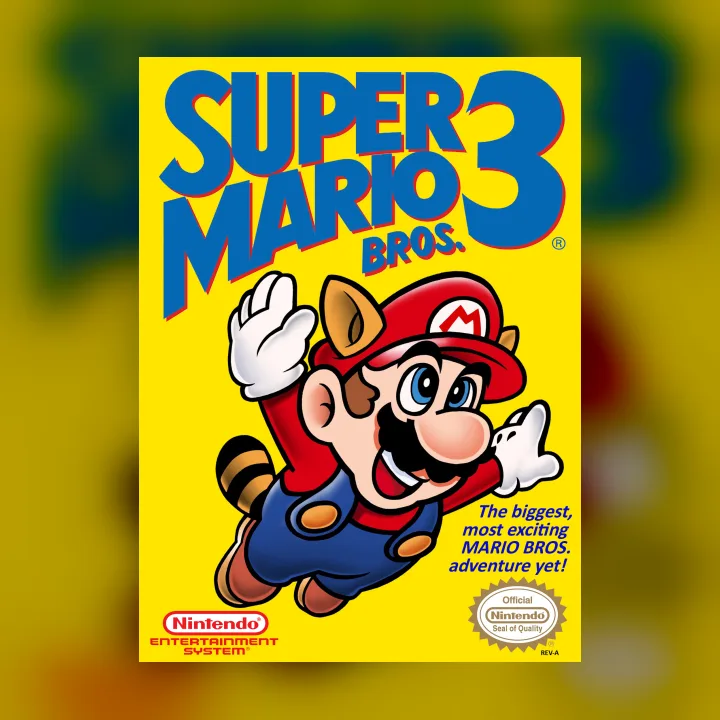
Super Mario Bros. 3
1988 · Nintendo · Platform · 1–2 players
Nintendo NES
Nintendo’s third NES Mario adventure added a world map, flying raccoon power-ups and the seven Koopalings – and went on to become one of the best-selling cartridges ever made.
The 1988 Nintendo NES game, free to play in your browser.
Runs in your browser, fullscreen. Keyboard, gamepad and touch controls. Your progress is saved on this device.
About Super Mario Bros. 3
Seven stolen wands and a theatre curtain
Bowser’s seven children, the Koopalings, have invaded the seven kingdoms of the Mushroom World and stolen each king’s magic wand. Mario and Luigi set out to recover them, one airship at a time, before Bowser himself becomes the final target in his own Dark Land.
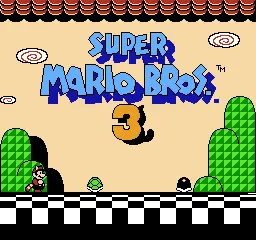
Shigeru Miyamoto has said the game was conceived as a stage play, and it shows. The title screen opens with a curtain rising, and in the original NES version some objects in the levels hang from catwalks just out of view, like props on a set. The Koopalings themselves were modelled on members of the development team; their names – Larry, Morton, Wendy, Iggy, Roy, Lemmy and Ludwig – were added by the North American localisers.
A world map with choices
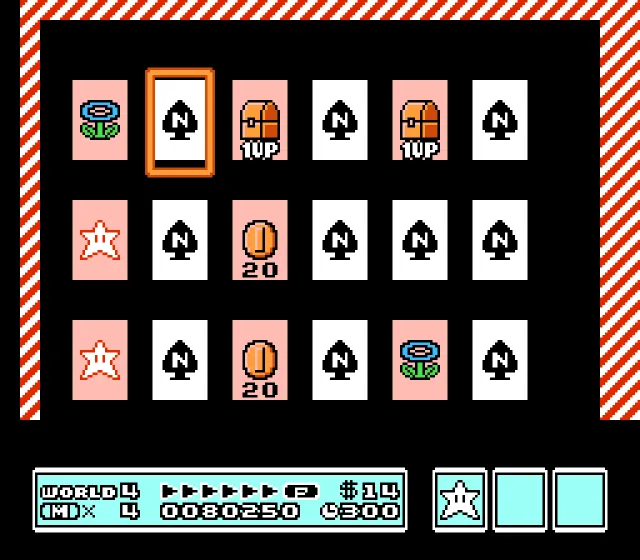
Super Mario Bros. 3 replaced the straight line of levels from earlier games with an overworld map. Each of the eight worlds – Grass Land, Desert Land, Water Land, Giant Land, Sky Land, Ice Land, Pipe Land and Dark Land – lets you choose your path, visit Toad Houses for items, play a card-matching game and a slot-machine-style bonus game, and fight wandering Hammer Brothers who guard treasure.
Items you collect go into an inventory that you can use from the map before entering a level, so a hard stage can be approached with exactly the right power-up. Each of the first seven worlds ends aboard a Koopaling’s airship, and the eighth pits you against Bowser.
Leaves, suits and the warp whistles
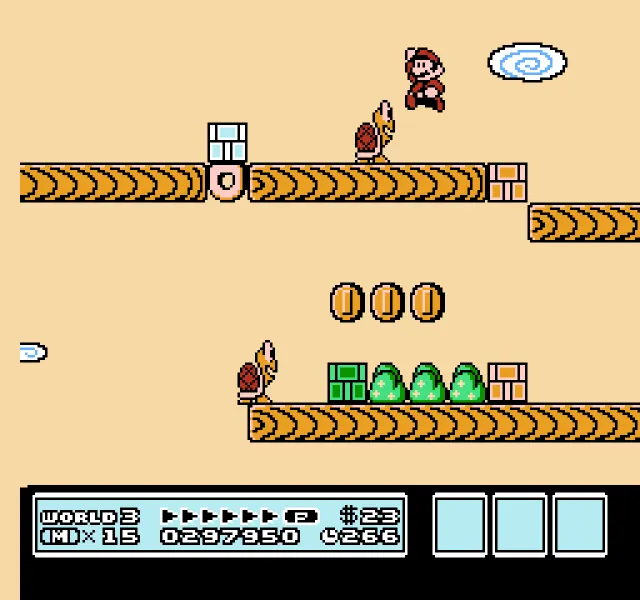
The power-ups are the stars. The Super Leaf gives Mario raccoon ears and a tail: get a running start until the power meter fills, and he can fly for a short while or slow his fall. The rarer Tanooki Suit adds the ability to turn briefly into a stone statue that enemies cannot harm. The Frog Suit makes swimming far easier, and the Hammer Suit lets Mario throw hammers and shrug off fireballs while crouching. A P-Wing keeps raccoon Mario flying for an entire level.
Then there are the warp whistles. Three are hidden in the first two worlds: one behind a white block at the end of World 1-3 (hold Down on it until Mario drops behind the scenery), one in the World 1 fortress above the ceiling, and one on the World 2 map, behind a rock you break with a hammer. Blowing a whistle takes you to a Warp Zone where you can jump ahead – two whistles are enough to go straight to World 8.
Two years in the making
The game was developed by Nintendo’s Entertainment Analysis and Development division, directed by Shigeru Miyamoto and Takashi Tezuka, with Toshihiko Nakago as main programmer and music by Koji Kondo. Development took more than two years. The cartridge uses Nintendo’s MMC3 chip, which allowed animated tiles, diagonal scrolling and the split-screen status bar.
The Famicom version came out in Japan on 23 October 1988. Americans got a preview in the 1989 film The Wizard, whose finale was built around the game, before the NES release on 12 February 1990; Europe followed on 29 August 1991. The NES game hosted on this page is the original 8-bit version, not the later Super Mario All-Stars remake. Super Mario Bros. 3 sold more than 17 million copies by 2000 and for a long time held the record as the best-selling game not bundled with a console.
Mario, Luigi and the battle game
Two players take turns on the same map, one as Mario and one as Luigi, each playing levels in turn. The two-player mode also includes a head-to-head mini-game remake of the original Mario Bros. arcade game: the winner can steal one of the other player’s cards, and the loser forfeits a turn. It is a simple but surprisingly competitive way to share the game when you play Super Mario Bros. 3 online with someone next to you.
Sources: en.wikipedia.org, mariowiki.com, giantbomb.com
Screenshots
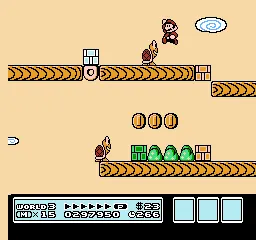
Game details
- Platform
- Nintendo NES
- Released
- 1988
- Developer
- Nintendo EAD
- Publisher
- Nintendo
- Genre
- Platform
- Players
- 1–2 players
- Famicom release (Japan)
- 23 October 1988
- NES release (North America)
- 12 February 1990
- NES release (Europe)
- 29 August 1991
- Directors
- Shigeru Miyamoto, Takashi Tezuka
- Composer
- Koji Kondo
- Cartridge hardware
- Nintendo MMC3 mapper chip
- Worlds
- 8, plus the Warp Zone (World 9)
- Sales
- Over 17 million copies by 2000
- Emulator
- FCEUmm
How to play Super Mario Bros. 3
Press Play: the game starts fullscreen in your browser, nothing to install. Press Esc or the ‹ Menu button to come back here; your progress is saved and you can continue next time.
Keyboard
| Arrow keys | Move |
|---|---|
| Z | A button |
| X | B button |
| Enter | Start |
| V | Select |
Gamepads (Xbox, PlayStation, Switch and most USB or Bluetooth pads) work as soon as you press a button; two pads give two players. On phones and tablets on-screen buttons appear. Keys can be changed in the emulator's Controls menu.
Super Mario Bros. 3 FAQ
Can I play Super Mario Bros. 3 online?
Yes – the original 8-bit NES cartridge, not the All-Stars remake, runs here for free in any modern browser. Fly with the Super Leaf using a keyboard, a gamepad or touch, and your progress is kept on your device.
Where are the warp whistles in Super Mario Bros. 3?
World 1-3 (crouch on the white block at the end to fall behind the scenery), the World 1 fortress (fly over the ceiling to a hidden door) and the World 2 map, behind a rock broken with a hammer.
How many worlds are in Super Mario Bros. 3?
Eight: Grass Land, Desert Land, Water Land, Giant Land, Sky Land, Ice Land, Pipe Land and Dark Land. The Warp Zone reached with whistles is sometimes called World 9.
Who are the Koopalings?
Bowser’s seven children, who each rule one of the first seven worlds from an airship. Super Mario Bros. 3 was their first appearance.
Is Super Mario Bros. 3 two-player?
Yes, two players alternate as Mario and Luigi, and the two-player mode includes a head-to-head mini-game based on the arcade Mario Bros.
Comments
No comments yet. Be the first!