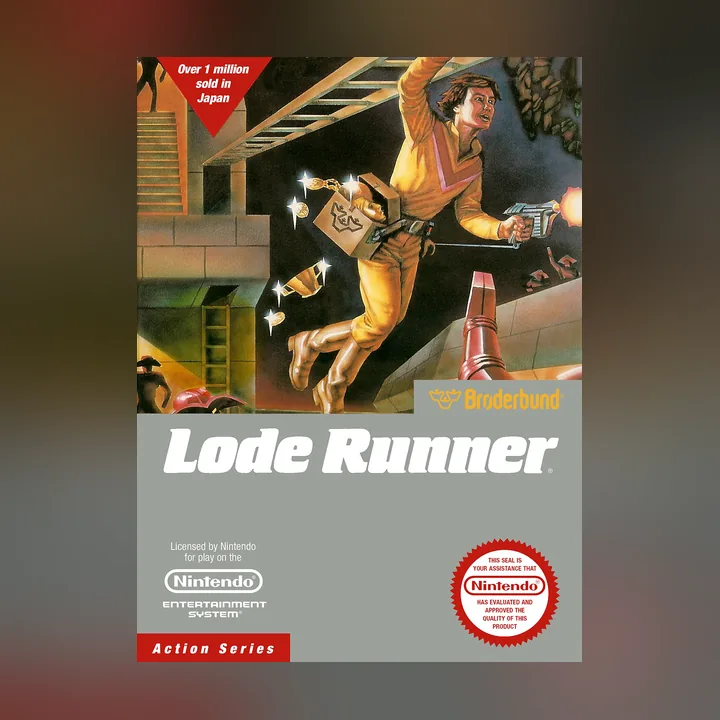
Lode Runner
1984 · Hudson Soft · Action, Platform, Puzzle · 1–2 players
Nintendo NES
You cannot jump and you have no weapon except a tool that digs holes. Hudson Soft’s NES version of Lode Runner turns that limit into 50 stages of gold-grabbing puzzles and enemy traps.
The 1984 Nintendo NES game, free to play in your browser.
Runs in your browser, fullscreen. Keyboard, gamepad and touch controls. Your progress is saved on this device.
About Lode Runner
Dig, trap, collect
Each stage is a maze of brick floors, ladders and hand-over-hand ropes with piles of gold scattered around it. Your runner can walk, climb and hang from ropes, but he cannot jump, so every route has to be worked out from those moves. Collect all the gold and a hidden ladder appears, leading off the top of the stage.
Your only tool is digging. The B button digs a hole in the floor diagonally down to your left, the A button does the same to your right. Holes fill themselves back in after a short time, which makes them both a way through the floor and a trap.
Dealing with the guards
Enemies move by the same rules you do and try to close in from several sides. Lure one over a hole and it drops in and is stuck for a moment, and you can even walk across its head. If the hole refills while the guard is still inside, it is removed and a replacement appears elsewhere on the stage.
Guards also pick up gold and carry it around, often dropping it when they fall into a hole. If the exit ladder refuses to appear, one of them is probably still carrying the last piece, so trap it and the gold comes loose.
From Apple II hit to Famicom favourite
Lode Runner was created by Doug Smith and published by Broderbund in 1983 for the Apple II, where it shipped with 150 levels and a level editor, one of the first games to let players build their own stages. It was the top-selling computer game in the United States during 1983.
Hudson Soft made the Famicom version in 1984, one of the console’s first third-party games. It has 50 stages, scrolling playfields, cartoon-style graphics, music and bonus fruit that appears for extra points. It had sold about 1.5 million cartridges in Japan by 1999. In North America, Broderbund published the NES cartridge in 1987, and Hudson followed up in Japan with Championship Lode Runner, a set of 50 harder stages.
Stage select, speed and the editor
The NES version is generous with options. Press Select at any time to open stage select and jump straight to any of the 50 stages. On that screen you can also change the game speed. There is a built-in editor for designing your own single-screen stages, though the North American NES had no way to store them, so levels are lost when you reset. In Japan, players could save their creations to the Family BASIC data recorder tape drive.
You start with five lives and gain one for every stage you clear. After stage 50 the game simply starts over at stage 1.
A link to Bomberman
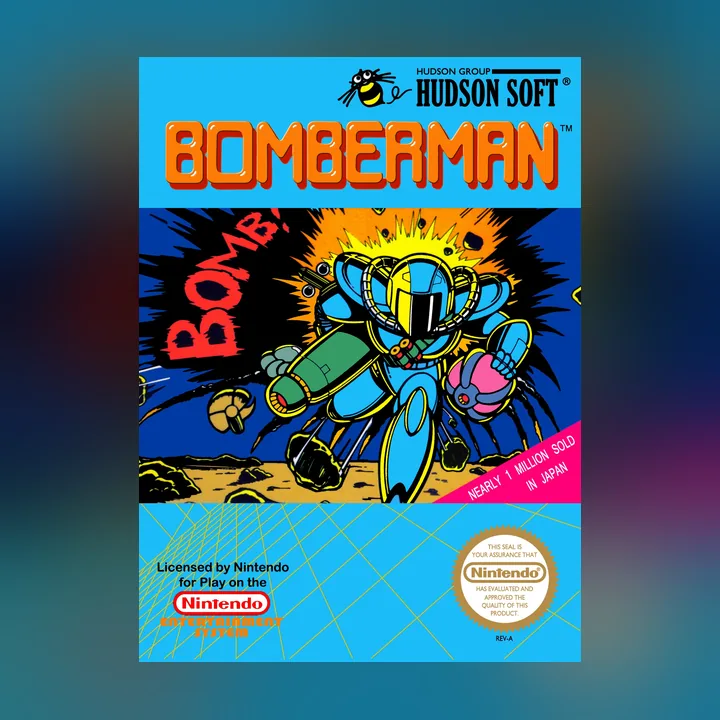
Hudson’s Lode Runner has an unexpected connection to another famous series. When Hudson made Bomberman for the Famicom in 1985, it gave the hero the look of the robot enemies from this Lode Runner port. Bomberman’s story is about a robot who becomes human by escaping to the surface, and its ending points to Lode Runner: the Japanese text says so directly, while the North American version only hints at it.
Puzzle tips
Because you dig diagonally, the space next to you, just above the brick you want to remove, has to be empty before the dig works. To get through two layers of brick, dig two holes side by side, drop in, then dig again. Watch for false bricks that look solid but let you and the guards fall straight through, and remember that solid stone blocks cannot be dug at all. Some gold can only be reached by falling onto it from above, so look at each stage before you move.
Sources: en.wikipedia.org, takeontheneslibrary.com, archive.org
Screenshots
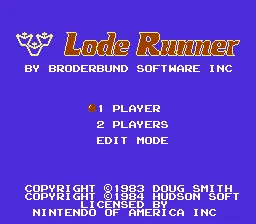
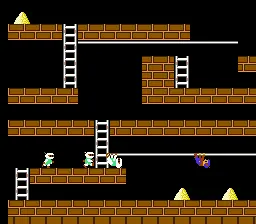
Game details
- Platform
- Nintendo NES
- Released
- 1984
- Developer
- Hudson Soft
- Publisher
- Hudson Soft
- Genre
- Action, Platform, Puzzle
- Players
- 1–2 players
- Japan release
- July 1984 (Famicom, Hudson Soft)
- North America release
- 1987 (NES, published by Broderbund)
- Stages
- 50, with stage select and speed setting
- Original game
- Doug Smith, Broderbund, Apple II, 1983 (150 levels)
- Japanese sales
- About 1.5 million cartridges
- Starting lives
- 5, plus one per cleared stage
- Follow-up
- Championship Lode Runner (Famicom)
- Emulator
- FCEUmm
How to play Lode Runner
Press Play: the game starts fullscreen in your browser, nothing to install. Press Esc or the ‹ Menu button to come back here; your progress is saved and you can continue next time.
Keyboard
| Arrow keys | Move |
|---|---|
| Z | A button |
| X | B button |
| Enter | Start |
| V | Select |
Gamepads (Xbox, PlayStation, Switch and most USB or Bluetooth pads) work as soon as you press a button; two pads give two players. On phones and tablets on-screen buttons appear. Keys can be changed in the emulator's Controls menu.
Lode Runner FAQ
Can I play Lode Runner online?
It is playable right here, free, with no install. Hudson Soft’s NES cartridge, stage select and editor included, runs in your browser and takes keyboard, gamepad or touch input, with progress saved on your device.
How many levels does NES Lode Runner have?
50 stages. You can choose any of them with the Select button, and after stage 50 the game loops back to stage 1.
How do you dig in Lode Runner on the NES?
Press B to dig a hole down and to the left, and A to dig down and to the right. The holes refill on their own after a short time.
Can you save levels in the Lode Runner editor?
Not on the NES. The Japanese Famicom version could save to the Family BASIC cassette data recorder, but the North American cartridge has no save option, so custom stages last only until you reset.
Comments
No comments yet. Be the first!