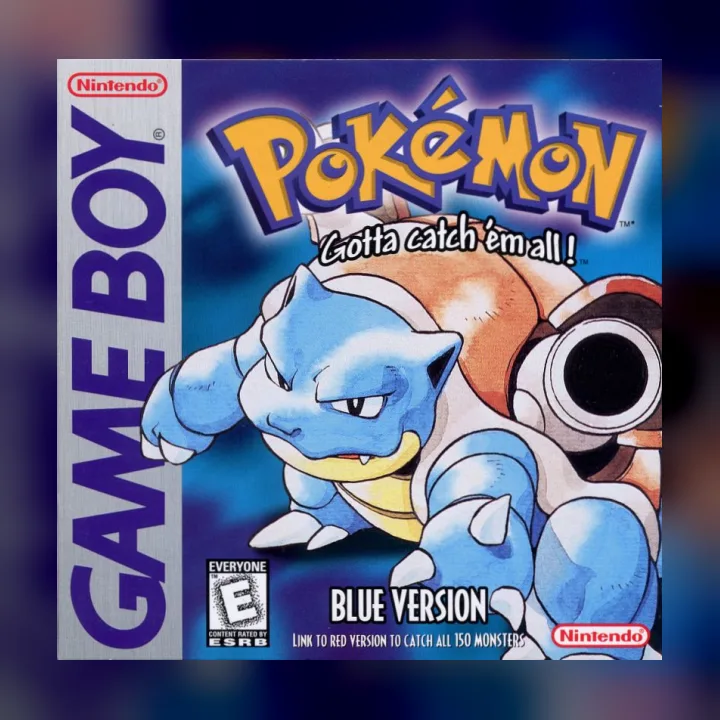
Pokémon Blue Version
1998 · Nintendo · Role-Playing · 1–2 players
Nintendo Game Boy
Same Kanto adventure, different wild Pokémon. Pokémon Blue swaps Red’s exclusives for Sandshrew, Vulpix, Meowth, Bellsprout, Magmar and Pinsir, and owes its look to a Japanese special edition. This is the USA/Europe Game Boy cartridge.
The 1998 Nintendo Game Boy game, free to play in your browser.
Runs in your browser, fullscreen. Keyboard, gamepad and touch controls. Your progress is saved on this device.
About Pokémon Blue Version
Blue’s own corner of Kanto
Pokémon Blue follows the same route as its partner: leave Pallet Town with a starter from Professor Oak, earn eight badges, stop Team Rocket and beat the Elite Four. What changes is who lives in the grass. Blue players can catch Sandshrew and Sandslash, Vulpix and Ninetales, Meowth and Persian, Bellsprout, Weepinbell and Victreebel, plus Magmar and Pinsir. None of them turn up in the wild in Red.
That list shapes a Blue team. Vulpix gives you a Fire option that evolves with a Fire Stone, Bellsprout is an easy Grass partner to raise, and Sandshrew is a sturdy Ground type for the Electric and Rock battles ahead. In return, Growlithe, Oddish, Ekans, Mankey, Scyther and Electabuzz are out of reach without a Red cartridge.
A name borrowed from a Japanese special edition
In Japan the series began in February 1996 with Pocket Monsters Red and Green. Later that year, on 15 October 1996, Pocket Monsters Blue appeared as a mail-order edition for readers of CoroCoro Comic, and it only reached Japanese shops in October 1999. Japanese Blue redrew the sprites of every Pokémon and redesigned the layout of the Unknown Dungeon, the cave where Mewtwo waits.
The English games took more from Japanese Blue than its name. They were reprogrammed using Japanese Blue’s code and artwork, but the wild Pokémon were divided as in the first Japanese pair. So the Blue on this page has the newer look of Japanese Blue and the exclusives of Japanese Green. It arrived in North America on 28 September 1998 and in Europe on 5 October 1999.
Built around the link cable
Satoshi Tajiri’s idea for Pokémon grew out of the hobby of insect collecting, and the Game Boy link cable gave it the final twist: players could swap creatures with each other. Nobody can complete all 151 Pokédex entries with one version, and four Pokémon, Kadabra, Machoke, Graveler and Haunter, only evolve when they are traded. Two linked games can also battle each other.
Later games kept the connection alive. Red and Blue can trade with Gold, Silver and Crystal, with limits on second-generation Pokémon and moves, and the 2016 Nintendo 3DS Virtual Console release simulated the link cable for trading and battles.
Mew, MissingNo. and a few tips
Mew, number 151, was slipped into the game by programmer Shigeki Morimoto at the very end of development. It cannot be caught in normal play: Nintendo handed it out at promotional events, and many players who missed them turned to cheat devices or glitches. The best-known glitch Pokémon, MissingNo., can be reached through a set of tricks, but glitches like this can scramble data, so it is best left alone on a save you want to keep.
For a smooth run, catch a Water or Grass Pokémon early if you chose Charmander, keep a few Potions and Antidotes in the bag and save before every Gym. Visit a Pokémon Center whenever your team is worn down.
Sources: en.wikipedia.org, serebii.net, bulbapedia.bulbagarden.net
Screenshots
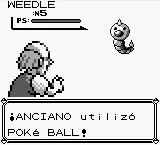
Game details
- Platform
- Nintendo Game Boy
- Released
- 1998
- Developer
- Game Freak
- Publisher
- Nintendo
- Genre
- Role-Playing
- Players
- 1–2 players
- North America release
- 28 September 1998
- Australia release
- 23 October 1998
- Europe release
- 5 October 1999
- Japanese Blue release
- 15 October 1996 (CoroCoro Comic mail order)
- Developer
- Game Freak
- Publisher
- Nintendo
- Pokémon designs
- Ken Sugimori
- Blue-exclusive Pokémon
- 11 (Sandshrew, Vulpix, Meowth and Bellsprout lines, Magmar, Pinsir)
- Companion version
- Pokémon Red
- Version on this page
- USA/Europe Game Boy cartridge (Super Game Boy enhanced)
- Emulator
- Gambatte
How to play Pokémon Blue Version
Press Play: the game starts fullscreen in your browser, nothing to install. Press Esc or the ‹ Menu button to come back here; your progress is saved and you can continue next time.
Keyboard
| Arrow keys | Move |
|---|---|
| Z | A button |
| X | B button |
| Enter | Start |
| V | Select |
Gamepads (Xbox, PlayStation, Switch and most USB or Bluetooth pads) work as soon as you press a button; two pads give two players. On phones and tablets on-screen buttons appear. Keys can be changed in the emulator's Controls menu.
Pokémon Blue Version FAQ
Is Pokémon Blue free to play online here?
Yes. The USA/Europe cartridge loads straight into this page with nothing to install. Play with a keyboard, a gamepad or touch controls, and your save stays in your browser.
What is the difference between Pokémon Red and Blue?
The story, maps and Gyms are the same. The difference is in the wild Pokémon: each version has eleven species the other lacks, so trading is needed to fill the Pokédex.
Can I trade or battle with another player here?
Not on this page. Link cable trading and two-player battles need two connected games, and this emulator runs a single game in your browser. You can still finish the adventure and beat the Elite Four alone.
Is English Pokémon Blue the same as Japanese Blue?
Not exactly. It uses the code and graphics of Japanese Blue, but its wild Pokémon match Japanese Green.
How do I get Mew in Pokémon Blue?
Mew was never catchable in normal play. Nintendo distributed it at official events, so a standard cartridge has no regular route to it.
Comments
No comments yet. Be the first!