Dr. Mario
1990 · Nintendo · Puzzle · 1–2 players
Nintendo NESNintendo Game Boy
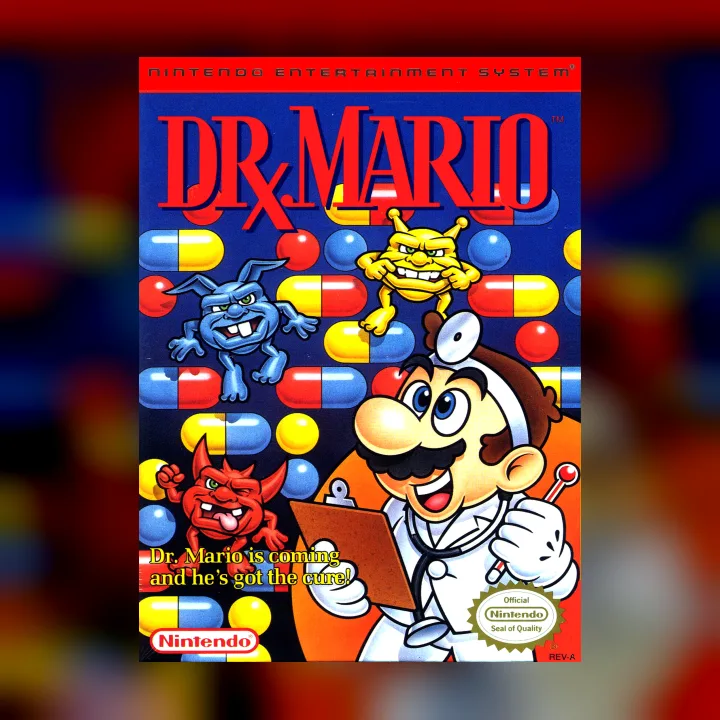
Mario swaps his overalls for a white coat and drops two-part capsules into a bottle full of viruses. Nintendo’s 1990 puzzle game arrived on the NES and the Game Boy at once, and both versions are here: the European NES cartridge and the Game Boy release.
The 1990 Nintendo NES game and the 1990 Nintendo Game Boy version, free to play in your browser.
Runs in your browser, fullscreen. Keyboard, gamepad and touch controls. Your progress is saved on this device.
About Dr. Mario
Four in a row cures the bottle
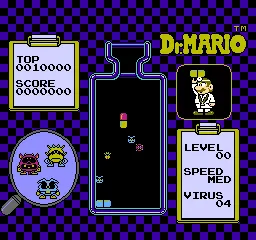
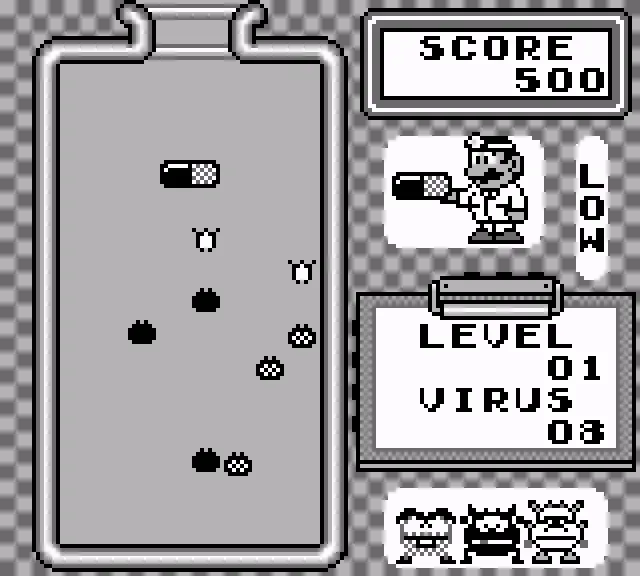
Every round starts with a medicine bottle full of viruses in three kinds – red, yellow and blue on the NES. The viruses never move. Dr. Mario throws in capsules made of two halves, and you slide and rotate them as they fall, with A and B turning them in opposite directions. When four or more matching pieces line up horizontally or vertically – viruses and capsule halves both count – they disappear.
Halves that lose their support drop down, and if they complete another line on the way, you get a chain. The round is won when the last virus is gone and lost when capsules block the narrow neck at the top of the bottle, a playfield eight cells wide and sixteen tall.
Level, speed and music
Before a game you choose a virus level from 0 to 20, a speed of Low, Med or Hi, and one of two songs, Fever or Chill, or no music. Level 0 has four viruses and each level adds four more, so level 20 starts with 84, the most the bottle ever holds.
Points come only from viruses. Destroying several with one capsule doubles the value for each extra one, and every virus is worth more at Med and Hi speed. Every fifth level on Med or Hi rewards you with a short cutscene.
Dr. Mario on Game Boy
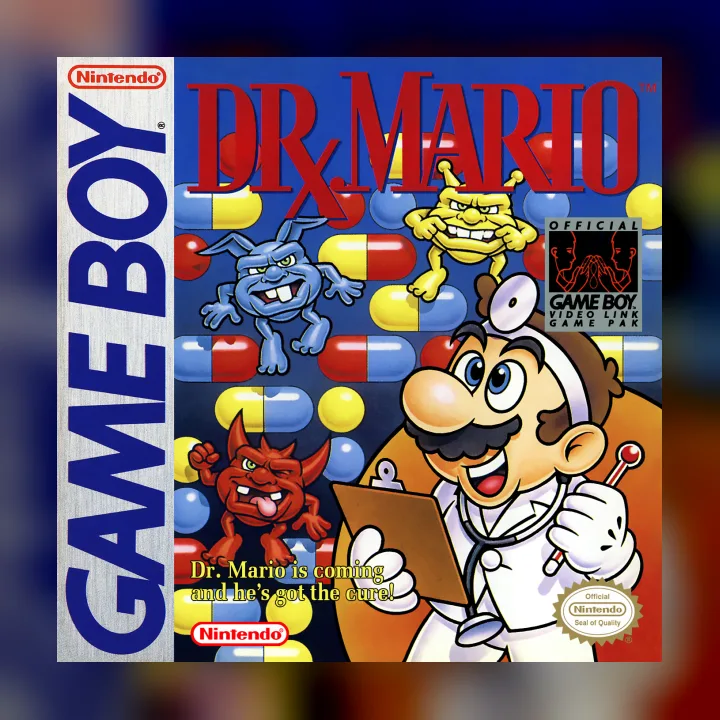
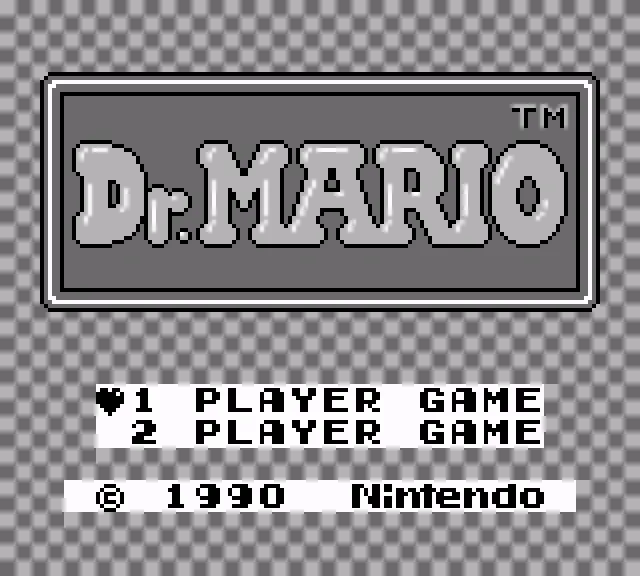
The Game Boy version came out on the same day as the Famicom one and plays by the same rules, with the same levels, speeds and both songs. Because the screen has no colour, the three virus types and capsule colours have to be told apart in shades of grey, which some reviewers felt made busy bottles harder to read.
There are small touches of its own. Clearing four or more lines in one move plays a quick snatch of the invincibility theme from Super Mario Bros., and the cutscenes take place on the sea floor, where creatures such as a pufferfish, a crab and a flying fish swim past the viruses. Head-to-head play needs two Game Boys joined by a Game Link Cable. The Game Boy cartridge sold 5.34 million copies, 2.08 million of them in Japan.
Nintendo’s answer to Tetris
Dr. Mario was made by Nintendo R&D1, the team behind the Game Boy, with Gunpei Yokoi as producer, Takahiro Harada as programmer and Hirokazu Tanaka writing the music. It launched on 27 July 1990 on the Famicom and the Game Boy in Japan, reached North America later in 1990 and Europe in 1991, at a time when Tetris was selling enormously on both systems. The NES cartridge sold 2.5 million copies in North America within six weeks.
The Fever theme became one of the best-known pieces of 8-bit music, and Dr. Mario himself later joined the Super Smash Bros. series as a fighter. In two-player mode clearing two or more lines with one capsule drops loose halves into the opponent’s bottle, and the first to win three rounds takes the match. The game was re-released many times, from the SNES compilation Tetris & Dr. Mario in 1994 to Nintendo’s online libraries on Switch, and sequels range from Dr. Mario 64 to Dr. Mario World.
Tips for higher levels
Clear the viruses near the top first, because a blocked neck ends the game no matter how many are left below. Avoid stacking a colour on top of a different virus unless you can remove it, and keep one column open to drop capsules deep into the bottle. The biggest scores come from chains, so leave half-finished lines that a single capsule can complete in sequence.
Sources: en.wikipedia.org, mariowiki.com
Versions
Dr. Mario is here in 2 versions. Each one plays in its own emulator.
Nintendo Game Boy
1990 · Nintendo R&D1 · Nintendo
Emulator: Gambatte · 20 KB
Play the Nintendo Game Boy versionScreenshots
Game details
- Platforms
- Nintendo NES, Nintendo Game Boy
- Released
- 1990
- Developer
- Nintendo (Nintendo NES), Nintendo R&D1 (Nintendo Game Boy)
- Publisher
- Nintendo
- Genre
- Puzzle
- Players
- 1–2 players
- Japan release
- 27 July 1990 (Famicom and Game Boy)
- North America release
- 1990 (NES and Game Boy)
- Europe release
- 1991 (NES and Game Boy)
- Developer
- Nintendo R&D1
- Producer
- Gunpei Yokoi
- Programmer
- Takahiro Harada
- Composer
- Hirokazu Tanaka
- Virus levels
- 0–20 to choose, 4 to 84 viruses
- Game Boy sales
- 5.34 million copies
- Version on this page
- European NES cartridge and Dr. Mario (World) (Rev 1) for Game Boy
- Emulators
- FCEUmm (Nintendo NES), Gambatte (Nintendo Game Boy)
How to play Dr. Mario
Press Play on the version you want: the game starts fullscreen in your browser, nothing to install. Press Esc or the ‹ Menu button to come back here; your progress is saved and you can continue next time.
Keyboard – Nintendo NES
| Arrow keys | Move |
|---|---|
| Z | A button |
| X | B button |
| Enter | Start |
| V | Select |
Keyboard – Nintendo Game Boy
| Arrow keys | Move |
|---|---|
| Z | A button |
| X | B button |
| Enter | Start |
| V | Select |
Gamepads (Xbox, PlayStation, Switch and most USB or Bluetooth pads) work as soon as you press a button; two pads give two players. On phones and tablets on-screen buttons appear. Keys can be changed in the emulator's Controls menu.
Dr. Mario FAQ
Can I play Dr. Mario online?
Sure – both the NES and the Game Boy cartridges open directly on this page, free and without a download. Use your keyboard, a game controller or the touch buttons on a phone.
How many viruses are there in Dr. Mario?
Level 0 starts with 4 viruses and each level adds 4, so level 20 has 84, the most the bottle ever holds.
What is different in the Game Boy version?
It plays the same way, but in shades of grey instead of colour, with undersea cutscenes, a Super Mario Bros. jingle for big clears and two-player play over a Game Link Cable.
What are the two songs in Dr. Mario called?
Fever and Chill. You pick one, or no music, on the options screen before the game starts.
Who made Dr. Mario?
Nintendo R&D1, produced by Gunpei Yokoi, programmed by Takahiro Harada and scored by Hirokazu Tanaka. It was released in 1990.
Comments
No comments yet. Be the first!