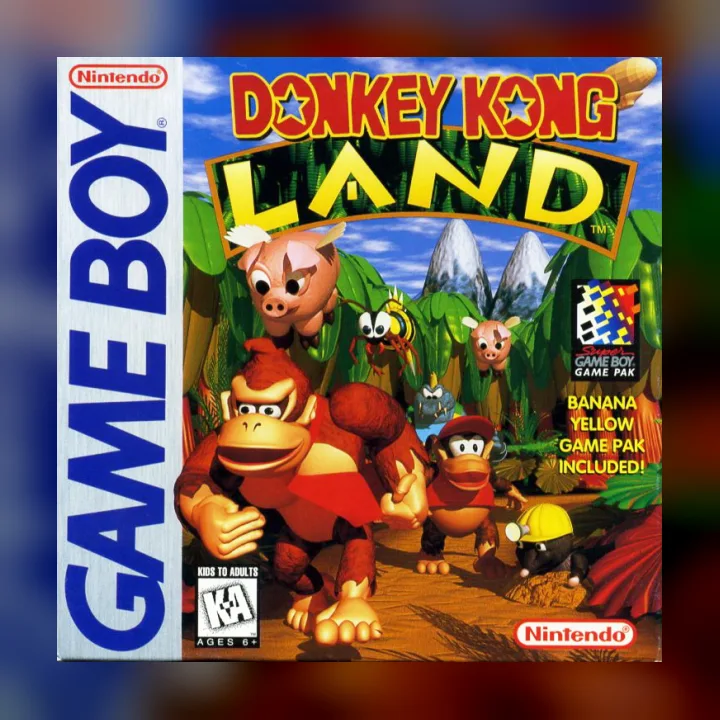
Donkey Kong Land
1995 · Nintendo · Platform · 1 player
Nintendo Game Boy
Rare’s first handheld Donkey Kong Country game is not a port: Donkey and Diddy chase King K. Rool through four new worlds, from a pirate ship to sunken Kremlantis and Big Ape City. Pre-rendered sprites, a yellow cartridge and Super Game Boy colour made it a 1995 hit.
The 1995 Nintendo Game Boy game, free to play in your browser.
Runs in your browser, fullscreen. Keyboard, gamepad and touch controls. Your progress is saved on this device.
About Donkey Kong Land
Cranky’s challenge
Donkey Kong Land opens with a jab from Cranky Kong. The old ape claims that Donkey Kong Country only succeeded because of its fancy graphics, and he dares Donkey Kong and Diddy to prove themselves again on a humble black-and-white Game Boy. Before long King K. Rool and his Kremlings have carried off the banana hoard once more, and the two Kongs set out to win it back.
The trip covers four worlds: Gangplank Galleon Ahoy!, the half-sunken ruins of Kremlantis, Monkey Mountains & Chimpanzee Clouds, and finally Big Ape City, reached by zeppelin. There are 30 regular stages in all, and every world ends with a boss: a flying stingray called Wild Sting, a Giant Clam, the mole Hard Hat and, last of all, K. Rool himself.
A new game, not a shrunken port
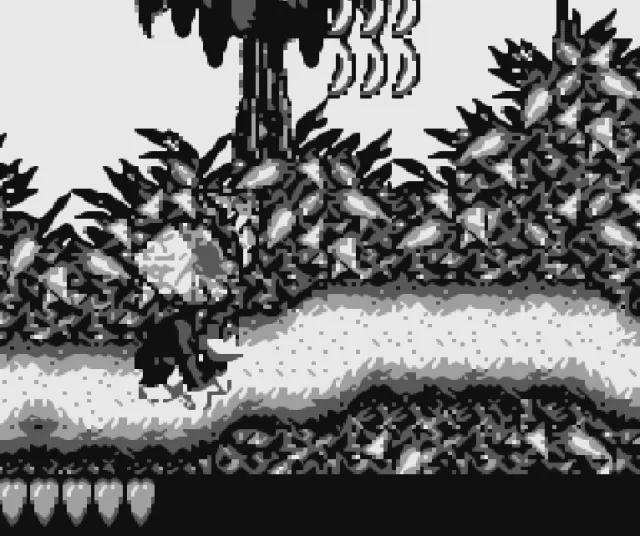
Programmer Paul Machacek suggested making an original adventure instead of squeezing the Super NES game onto a cartridge, and Rare co-founder Tim Stamper agreed. The team started work in 1994, while Donkey Kong Country itself was still in development, and grew from one person to more than fifteen. Like the console game, it turns pre-rendered 3D models into sprites, which pushed the Game Boy hard, especially on slopes and animated items.
The result borrows the look and the moves of Country but none of its level layouts. Cloud stages, a city and new enemies such as flying pigs are all new, while some familiar features were trimmed: only Rambi the rhino and Expresso the ostrich appear as animal friends, there is no Enguarde for underwater stages, and only one Kong is ever on screen. Graeme Norgate converted David Wise’s music to the Game Boy sound chip and added tracks of his own.
Controls and saving
The A button jumps and, tapped repeatedly, swims. B makes Donkey roll or Diddy cartwheel, and it also picks up a barrel, which flies when you let go. Select swaps between the two Kongs once you have freed your partner from a DK barrel, or lets you climb off an animal, and Start pauses. Pressing Start and Select together leaves a stage you have already cleared.
Saving works differently from the Super NES game. There are three save slots on the battery-backed cartridge, but you can only reach the save screen by collecting all four K-O-N-G letters in a stage and then finishing it. Sparkling continue points mark where you restart after losing a life, a hundred bananas give an extra life, and Kong Tokens can be spent in bonus areas for a shot at more lives.
Yellow cartridge, colour on the TV
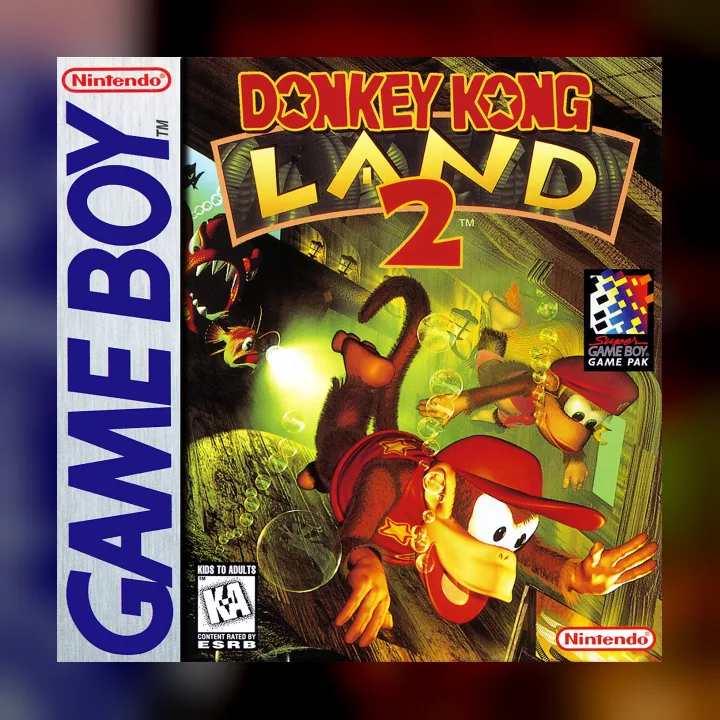
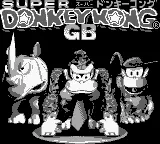
Nintendo released Donkey Kong Land in North America on 26 June 1995, in Japan on 27 July as Super Donkey Kong GB, and in Europe on 24 August. It came on a banana-yellow cartridge instead of the usual grey, starting a tradition the sequels kept. The game was also built for the Super Game Boy, which adds colour palettes and a jungle border when you play on a television.
Critics praised how much of Country’s feel survived, and GamePro named it the best Game Boy game of 1995, though some found the detailed graphics hard to read on the small monochrome screen. It sold 3.91 million copies, more than any other Donkey Kong game on the Game Boy. This page runs the USA and Europe cartridge with its Super Game Boy enhancements.
Tips for the jungle
Keep both Kongs whenever you can, since a second Kong works as a spare hit. Hunt down the K-O-N-G letters early in each world, because they are your only way to save, and look for barrel-shaped bombs: they clear the boulders that block paths on the map.
Sources: en.wikipedia.org, mariowiki.com, videogamemanual.com
Screenshots
Game details
- Platform
- Nintendo Game Boy
- Released
- 1995
- Developer
- Rare
- Publisher
- Nintendo
- Genre
- Platform
- Players
- 1 player
- North America release
- 26 June 1995
- Japan release
- 27 July 1995, as Super Donkey Kong GB
- Europe release
- 24 August 1995
- Developer
- Rare
- Publisher
- Nintendo
- Music
- Graeme Norgate, with conversions of David Wise’s Donkey Kong Country score
- Structure
- 4 worlds, 30 regular stages and 4 bosses
- Saving
- 3 battery save slots, unlocked by collecting K-O-N-G
- Sales
- 3.91 million copies
- Version on this page
- USA and Europe Game Boy cartridge (Super Game Boy enhanced)
- Emulator
- Gambatte
How to play Donkey Kong Land
Press Play: the game starts fullscreen in your browser, nothing to install. Press Esc or the ‹ Menu button to come back here; your progress is saved and you can continue next time.
Keyboard
| Arrow keys | Move |
|---|---|
| Z | A button |
| X | B button |
| Enter | Start |
| V | Select |
Gamepads (Xbox, PlayStation, Switch and most USB or Bluetooth pads) work as soon as you press a button; two pads give two players. On phones and tablets on-screen buttons appear. Keys can be changed in the emulator's Controls menu.
Donkey Kong Land FAQ
Is Donkey Kong Land playable online here?
It is. The USA and Europe Game Boy cartridge starts directly in your browser with nothing to install. A keyboard, a connected gamepad or the on-screen buttons on a phone all work.
Is Donkey Kong Land the same game as Donkey Kong Country?
No. It shares the characters, graphics style and moves, but Rare designed all-new levels, enemies and bosses for the Game Boy.
How do you save in Donkey Kong Land?
Collect all four K-O-N-G letters in a stage and finish it. The save screen then lets you store your progress in one of three slots.
How do you switch between Donkey and Diddy?
Press Select. You need both Kongs first, so break open a DK barrel to free your partner.
What does the Super Game Boy add?
On a Super Game Boy the game shows extra colour palettes and a jungle-themed border around the screen.
Comments
No comments yet. Be the first!