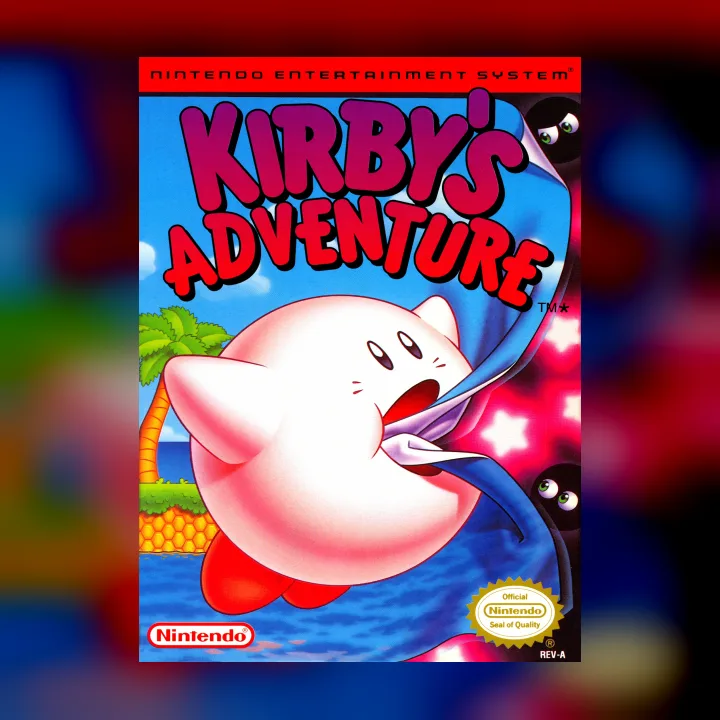
Kirby's Adventure
1993 · Nintendo · Action, Platform · 1 player
Nintendo NES
Kirby’s first colour adventure is also where he learned to copy enemies’ powers. HAL Laboratory’s 1993 NES platformer sends him through seven worlds to rebuild the broken Star Rod and save Dream Land’s dreams.
The 1993 Nintendo NES game, free to play in your browser.
Runs in your browser, fullscreen. Keyboard, gamepad and touch controls. Your progress is saved on this device.
About Kirby's Adventure
Why nobody in Dream Land is dreaming
Dream Land’s sleep comes from the Fountain of Dreams, powered by the Star Rod. When the dreams stop, Kirby discovers that King Dedede has taken the rod, broken it into pieces and handed them to his strongest minions. Kirby sets off to collect every fragment, unaware that Dedede may have had a reason.
Once the rod is whole and returned to the fountain, the real threat shows itself: Nightmare, who had been corrupting the fountain all along. The final battle against him takes place in space, with the Star Rod as Kirby’s weapon.
Copy Abilities make their debut
The first Kirby game on Game Boy let him inhale enemies and spit them back out. Kirby’s Adventure added the twist that defines the series: swallow certain enemies and Kirby takes on their power. Fire, ice, a sword, a parasol, a beam, a sleepy cap that does nothing at all – HAL tested more than 40 ideas and kept the ones the team liked best.
Abilities change how you approach each level, and some bosses become far easier with the right one. While Kirby holds a power he cannot inhale, but he can drop it at any time to try something else, and he can still float over most trouble by puffing up.
Seven worlds, 41 levels and plenty of side games
The game is divided into seven worlds. Each one has a hub area, between four and six regular stages, a boss fight against the holder of a Star Rod piece and a Warp Star door that takes you back to earlier worlds. In all there are 41 levels.
Between stages, the hubs hold mini-games such as Crane Fever, Egg Catcher and the reflex duel Quick Draw Kirby, which reward extra lives. Progress is saved automatically after each level on the cartridge’s battery-backed memory, so you never need passwords. Eagle-eyed players will also spot an early Meta Knight: he appears here for the first time, as an unnamed boss.
Sakurai, Iwata and a late NES showcase
Masahiro Sakurai, Kirby’s creator, directed and designed the game at HAL Laboratory, with Satoru Iwata among the producers alongside Shigeru Miyamoto and Takao Shimizu, and Hirokazu Ando composing the music. It came out on 23 March 1993 in Japan, in May 1993 in North America and in Europe later that year – years after the Super Famicom had already launched.
Squeezing so much into an NES game required a 6-megabit cartridge, one of the largest made for the console. It is also the first game to show Kirby in colour as pink, which Sakurai says he had always intended. GamePro named it its NES Game of the Year for 1993, and HAL later remade it for Game Boy Advance as Kirby: Nightmare in Dream Land in 2002.
Tips for a full save file
Keep a strong ability, like the sword or fire, when you enter a boss room – it is easier than fighting with inhaled projectiles. When Kirby is hit, his power pops out as a bouncing star; inhale it again quickly before it vanishes to keep the ability.
Hubs hide extra content that you unlock as you explore, and you can replay finished stages to stock up on extra lives or pick up a specific ability. Pressing every hidden switch and then beating the game opens an Extra Game in which Kirby has half his usual health and progress is not saved; clearing that unlocks a music player option.
Sources: en.wikipedia.org, wikirby.com, classic-games.net, vgfacts.com
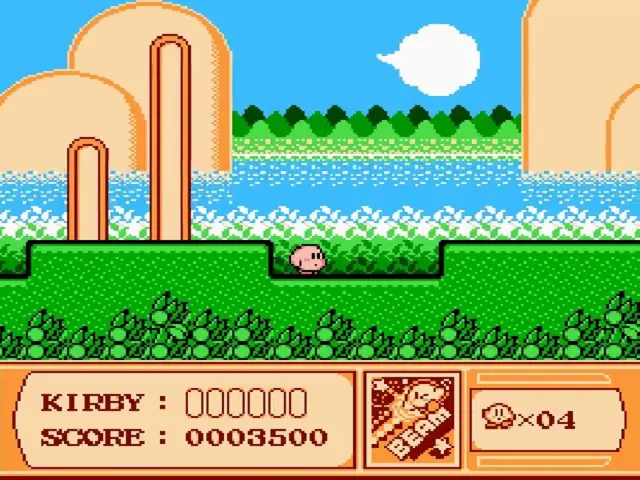
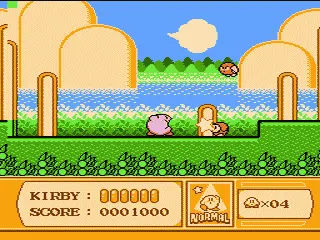
Screenshots
Game details
- Platform
- Nintendo NES
- Released
- 1993
- Developer
- HAL Laboratory
- Publisher
- Nintendo
- Genre
- Action, Platform
- Players
- 1 player
- Japan release
- 23 March 1993 (Famicom)
- North America release
- May 1993 (NES)
- Director
- Masahiro Sakurai
- Composer
- Hirokazu Ando
- Cartridge
- 6 megabits with battery-backed save
- Firsts
- First Copy Abilities, first Meta Knight, first colour Kirby
- Remake
- Kirby: Nightmare in Dream Land (Game Boy Advance, 2002)
- Emulator
- FCEUmm
How to play Kirby's Adventure
Press Play: the game starts fullscreen in your browser, nothing to install. Press Esc or the ‹ Menu button to come back here; your progress is saved and you can continue next time.
Keyboard
| Arrow keys | Move |
|---|---|
| Z | A button |
| X | B button |
| Enter | Start |
| V | Select |
Gamepads (Xbox, PlayStation, Switch and most USB or Bluetooth pads) work as soon as you press a button; two pads give two players. On phones and tablets on-screen buttons appear. Keys can be changed in the emulator's Controls menu.
Kirby's Adventure FAQ
Can I play Kirby’s Adventure online?
Sure – HAL’s 1993 NES cartridge runs here in the browser for free, so you can start inhaling enemies right away with keyboard, controller or touch input. The game’s own save file is kept on your device between visits.
How many levels are in Kirby’s Adventure?
There are 41 levels spread across seven worlds, plus mini-games in the hub areas.
Who is the final boss of Kirby’s Adventure?
Nightmare. King Dedede is fought first, but Nightmare is the true villain who had been corrupting the Fountain of Dreams.
Is Kirby’s Adventure the first game with copy abilities?
Yes. Kirby’s Adventure introduced the Copy Ability, which became a staple of the series.
Does Kirby’s Adventure save your progress?
Yes, it saves automatically after each level, so there are no passwords.
Comments
No comments yet. Be the first!