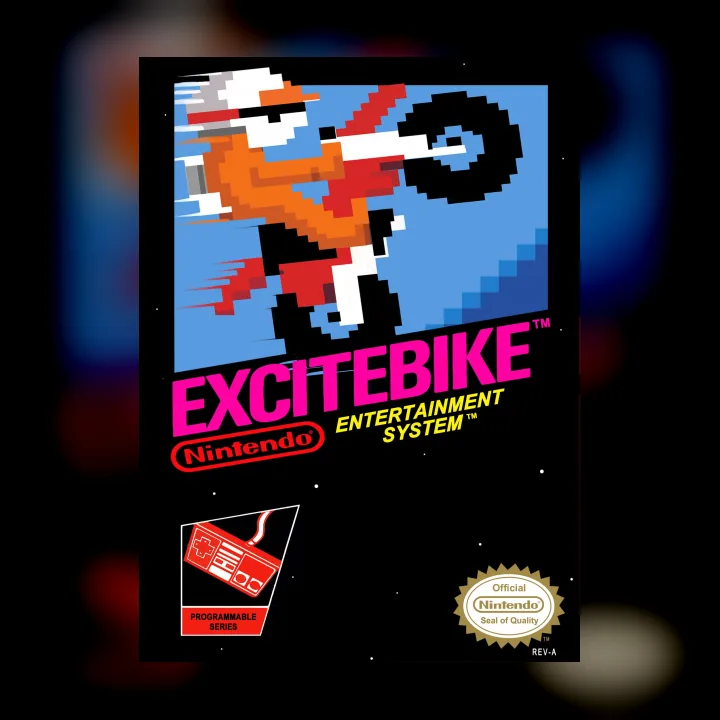
Excitebike
1984 · Nintendo · Racing · 1 player
Nintendo NES
Hit the ramps, nurse an overheating engine and land on both wheels. Nintendo’s side-scrolling motocross game from 1984 also lets you build your own course, a rare feature on an early NES cartridge.
The 1984 Nintendo NES game, free to play in your browser.
Runs in your browser, fullscreen. Keyboard, gamepad and touch controls. Your progress is saved on this device.
About Excitebike
Throttle, turbo and a temperature gauge
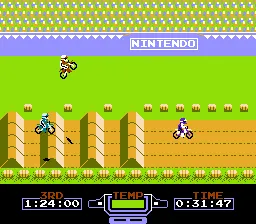
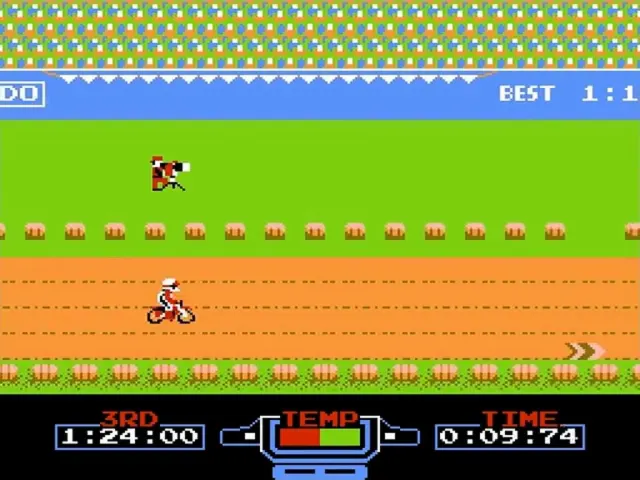
Excitebike looks simple: one rider, a side-on dirt track, a row of ramps. The clever part is the engine. The A button is your normal throttle, while the B button gives a turbo that is much faster but steadily heats the engine. Let the temperature bar reach the top and the bike stops dead while it cools, often costing you the race.
Arrows painted on the track reset the temperature when you ride over them, so a good lap is planned around those cooling points. The control pad moves you between the four lanes and, in the air, tilts the rider forward or back. Land with both wheels together and you keep your speed; come down nose-first or on the back wheel and you lose momentum or crash.
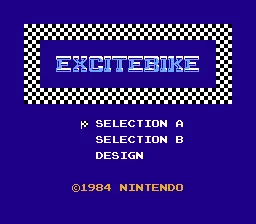
Selection A, Selection B and Design mode
The title screen offers three choices. Selection A puts you on the track alone against the clock, while Selection B adds computer-controlled riders who get in your way and can knock you over. In both, you need to finish in the top three of a preliminary race to qualify for the championship race, and later tracks bring rough patches, gaps and narrow two-lane sections.
Design mode is the part many players remember. You lay out a course from 19 kinds of pieces – mud, hurdles and ramps, including a big super jump – and then race on your own creation. In Japan, designs could be stored on tape with the Famicom Data Recorder, an accessory that was never released elsewhere, so on a Western NES there was no official way to keep a course.
Miyamoto, Nakago and a scrolling engine reused by Mario
Shigeru Miyamoto directed, designed and produced the game, Toshihiko Nakago handled the programming and Akito Nakatsuka wrote the music. The Famicom version came out in Japan on 30 November 1984, and the NES cartridge followed in North America on 18 October 1985, as part of the console’s launch period there.
The work done here carried over to Nintendo’s next big project. The smooth scrolling technology built for Excitebike was reused in Super Mario Bros. in 1985, helping Mario speed up gradually from a walk into a run.
An arcade version, Vs. Excitebike, ran on Nintendo’s VS. System and ranked second among arcade system games in American earnings for 1985, behind Hogan’s Alley. A 1988 Famicom Disk System release of Vs. Excitebike added a two-player mode and disk saving for custom tracks.
Sequels and later appearances
The name went on to a full series: Excitebike 64 in 2000, Excite Truck in 2006, Excitebots: Trick Racing and the WiiWare game Excitebike: World Rally in 2009. The original was also re-released many times, including as a bonus inside Excitebike 64, an unlockable NES game in Animal Crossing on GameCube, a 3D Classics version on Nintendo 3DS and the NES Classic Edition. An Excitebike-themed course even appears in Mario Kart 8.
How to set faster times
Use turbo in short bursts and aim to hit the cooling arrows just before the gauge gets dangerous. Take-off angle matters: pulling the front up sends you higher but shorter, leaning forward gives a lower, longer jump. Before touching down, match the bike’s angle to the slope of the ground; a clean landing is the single biggest time saver. Raising the front wheel also lets you wheelie over small bumps.
Avoid the dark rough patches by changing lanes early, and in Selection B give the computer riders room, because a collision is far more costly than a short delay – although your own rear wheel can knock a rival over if you land just ahead of him. In Design mode, try building a track around one long jump section to practise landings.
Sources: en.wikipedia.org, nintendo.com
Screenshots
Game details
- Platform
- Nintendo NES
- Released
- 1984
- Developer
- Nintendo R&D4
- Publisher
- Nintendo
- Genre
- Racing
- Players
- 1 player
- Japan release
- 30 November 1984 (Famicom)
- North America release
- 18 October 1985 (NES)
- Director and designer
- Shigeru Miyamoto
- Programmer
- Toshihiko Nakago
- Composer
- Akito Nakatsuka
- Series
- First game in Nintendo’s Excite series
- Design mode
- 19 types of track pieces
- Developer
- Nintendo R&D4
- Emulator
- FCEUmm
How to play Excitebike
Press Play: the game starts fullscreen in your browser, nothing to install. Press Esc or the ‹ Menu button to come back here; your progress is saved and you can continue next time.
Keyboard
| Arrow keys | Move |
|---|---|
| Z | A button |
| X | B button |
| Enter | Start |
| V | Select |
Gamepads (Xbox, PlayStation, Switch and most USB or Bluetooth pads) work as soon as you press a button; two pads give two players. On phones and tablets on-screen buttons appear. Keys can be changed in the emulator's Controls menu.
Excitebike FAQ
Can I play Excitebike online?
Yes – this NES cartridge, Design mode included, runs in your browser here without charge. Throttle and turbo map to a keyboard, gamepad or touch buttons, and progress is saved locally on your device.
How do you stop the bike overheating in Excitebike?
Use the B button turbo sparingly and ride over the arrows on the track, which reset the engine temperature.
Can you save tracks in Excitebike on the NES?
Not officially. Saving designs needed the Famicom Data Recorder, a tape accessory released only in Japan.
Is Excitebike two-player?
The NES version is for one player. A two-player mode was added in the 1988 Famicom Disk System release of Vs. Excitebike.
Comments
No comments yet. Be the first!