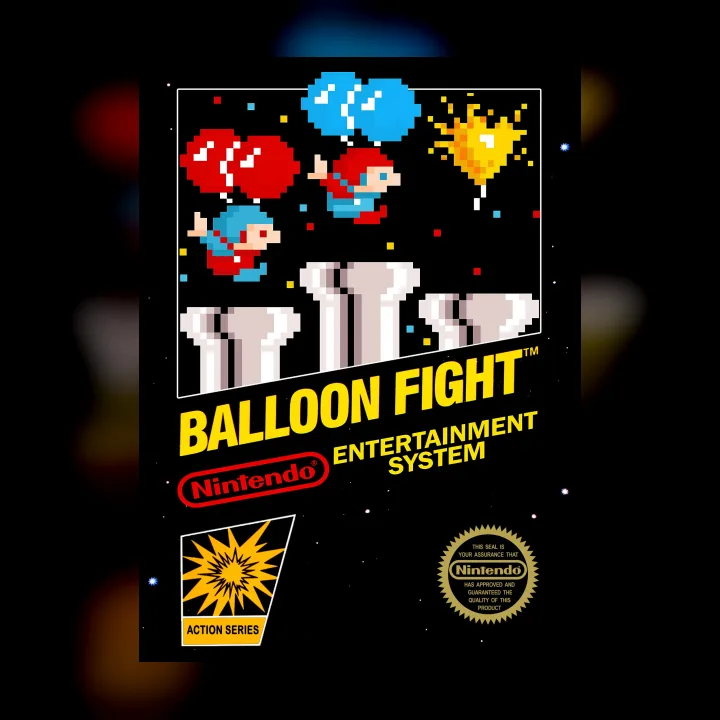
Balloon Fight
1985 · Nintendo · Action, Platform · 1–2 players
Nintendo NES
Two balloons, one flapping hero and a lake with something hungry beneath it. Nintendo’s NES aerial brawler is a quick lesson in momentum, and its endless Balloon Trip mode has eaten many evenings since 1985.
The 1985 Nintendo NES game, free to play in your browser.
Runs in your browser, fullscreen. Keyboard, gamepad and touch controls. Your progress is saved on this device.
About Balloon Fight
Keep flapping, keep your balloons
Your Balloon Fighter floats on two balloons and stays airborne only as long as you keep flapping his arms. Tap the A button for single flaps or hold the B button to flap continuously, and steer with the D-pad. Getting the rhythm right is the whole game: too little lift and you sink toward the water, too much and you drift straight into danger.
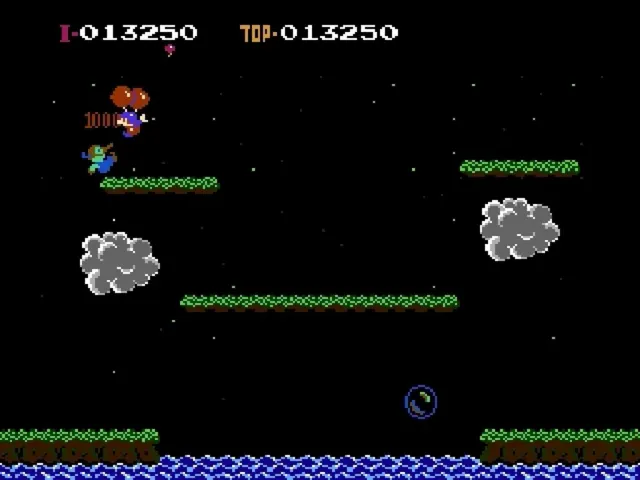
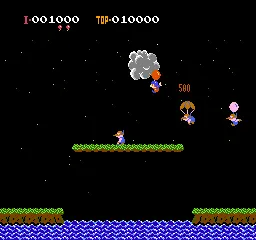
Enemies drift around the screen on balloons of their own. Hit one of their balloons from above and they parachute down; catch them before they land, or knock them off a platform, and they are gone for good. Leave a grounded enemy alone and he simply pumps up a fresh balloon and returns to the fight.
Your own balloons are just as fragile. Lose one and you fall more heavily and climb more slowly; lose both and that life is over. Lightning sparks bounce around later stages, and a large fish lurks at the surface of the water, ready to drag down anyone who flies too low.
Three ways to play the NES cartridge
The main mode can be played alone or by two players at the same time, each starting with three spare lives. Defeated enemies that fall into the lake leave a bubble that you can pop for extra points, and each new phase adds more enemies and more awkward platform layouts. Playing co-op is chaotic in the best way, because a careless partner can bump you straight into a spark.
Every three phases a bonus round interrupts the action: balloons float up from below and you pop as many as you can before they float away.
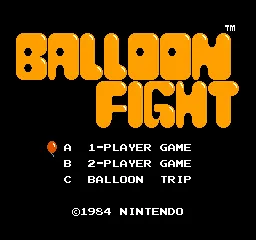
Balloon Trip is the mode many players remember most. It is single-player, you get exactly one life, and the screen scrolls sideways while you dodge a sky full of sparks and collect balloons for points. There is no end, only a high score to chase, which makes it ideal for short sessions in the browser.
From the VS. System to the Famicom
Balloon Fight began in 1984 as VS. Balloon Fight, an arcade game on Nintendo’s VS. System. The home version reached the Famicom in Japan on 22 January 1985 and arrived on the NES in North America in 1986. The arcade release lacks Balloon Trip, which was added for the home cartridge.
The game was made by Nintendo R&D1 together with HAL Laboratory. Gunpei Yokoi produced it, Yoshio Sakamoto handled design and art, and the programming was done by Satoru Iwata, who later became Nintendo’s president. Hirokazu Tanaka wrote the music. Its flapping combat is often compared to Williams’ 1982 arcade game Joust.
A long tail of cameos
Nintendo has kept Balloon Fight alive for decades. It returned on the e-Reader, the Game Boy Advance Famicom Mini line, several Virtual Console services and the NES Classic Edition, and in 2013 it was the first title released on the Wii U Virtual Console. A Game Boy follow-up, Balloon Kid, appeared in 1990.
Fans of Super Smash Bros. will recognise the Balloon Fight stage and the Villager’s balloon-powered recovery move, while WarioWare: Smooth Moves and Nintendo Land both built minigames around the Balloon Trip idea.
Tips for surviving the sky
Approach enemies from above whenever you can, so that you meet their balloons rather than letting them reach yours. Stay away from the bottom edge of the screen, since the fish strikes fast and offers no second chance. When an enemy lands on a platform, hurry over and bump him before his new balloon is fully inflated.
In Balloon Trip, gentle tapping works better than holding the button. Keep to the middle third of the screen so you have room to react to sparks coming from both above and below.
Sources: en.wikipedia.org
Screenshots
Game details
- Platform
- Nintendo NES
- Released
- 1985
- Developer
- Nintendo R&D1
- Publisher
- Nintendo
- Genre
- Action, Platform
- Players
- 1–2 players
- Japan release
- 22 January 1985 (Famicom)
- North America release
- 1986 (NES)
- Arcade origin
- VS. Balloon Fight, 1984 (Nintendo VS. System)
- Developers
- Nintendo R&D1 with HAL Laboratory
- Producer
- Gunpei Yokoi
- Designer
- Yoshio Sakamoto
- Programmer
- Satoru Iwata
- Composer
- Hirokazu Tanaka
- Sequel
- Balloon Kid (Game Boy, 1990)
- Emulator
- FCEUmm
How to play Balloon Fight
Press Play: the game starts fullscreen in your browser, nothing to install. Press Esc or the ‹ Menu button to come back here; your progress is saved and you can continue next time.
Keyboard
| Arrow keys | Move |
|---|---|
| Z | A button |
| X | B button |
| Enter | Start |
| V | Select |
Gamepads (Xbox, PlayStation, Switch and most USB or Bluetooth pads) work as soon as you press a button; two pads give two players. On phones and tablets on-screen buttons appear. Keys can be changed in the emulator's Controls menu.
Balloon Fight FAQ
Can I play Balloon Fight online?
Yes. This page runs the Famicom/NES cartridge in your browser for free, Balloon Trip included. Flap with a keyboard, a gamepad or touch controls; progress is saved locally on your device.
Is Balloon Fight a two-player game?
Yes. The main mode supports two players at the same time, working together to clear each phase. Balloon Trip is single-player only.
What is Balloon Trip?
It is an endless single-player mode with one life. The screen scrolls while you avoid electric sparks and collect balloons, and the goal is simply the highest score you can reach.
Who programmed Balloon Fight?
The NES version was programmed by Satoru Iwata of HAL Laboratory, who later became president of Nintendo.
Comments
No comments yet. Be the first!