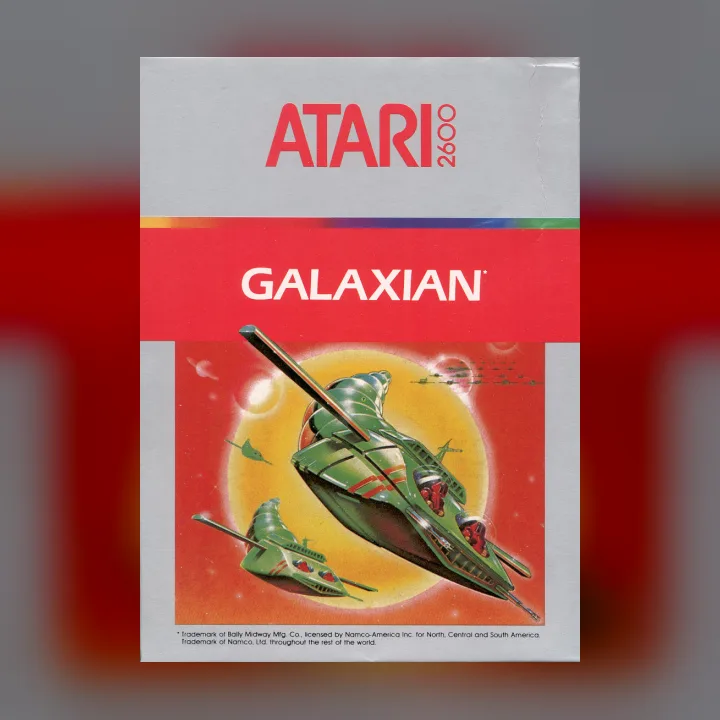
Galaxian
1983 · Atari · Shooter · 1 player
Atari 2600
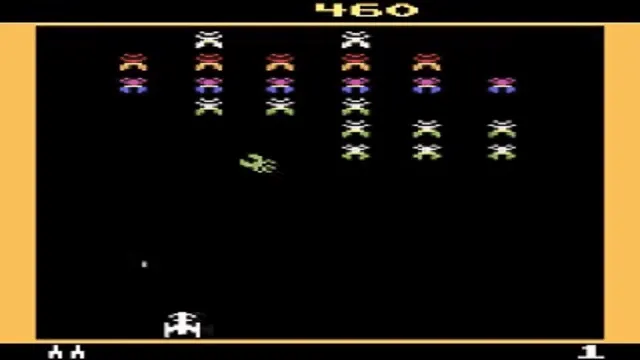
Before Galaga there was Galaxian. Atari’s 1983 cartridge brought Namco’s swooping alien fleet to the 2600, using a clever programming trick to squeeze far more moving sprites onto the screen than the console was designed for.
The 1983 Atari 2600 game, free to play in your browser.
Runs in your browser, fullscreen. Keyboard, gamepad and touch controls. Your progress is saved on this device.
About Galaxian
Aliens that leave the formation
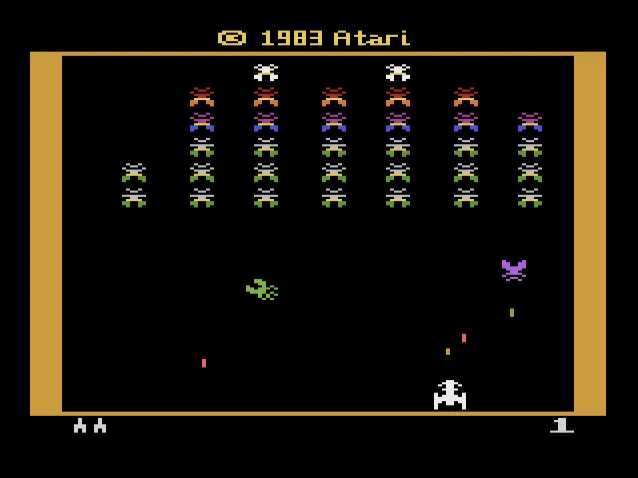
The set-up looks familiar: a fleet of aliens hangs in rows at the top of the screen, and you slide a single ship left and right along the bottom, firing upward. The twist that made Galaxian stand out from Space Invaders is that the enemies do not simply march. Individual aliens peel away from the formation and dive towards you, shooting as they come, then loop back to rejoin the group.
That changes how you play. Instead of chipping away at a slowly descending wall, you are constantly tracking attackers in motion, deciding whether to shoot a diver before it reaches you or slip out of its path. Clearing a whole wave brings on the next one, and later waves are more aggressive.
Hunting the flagship
At the top of the formation sit the flagships. In the arcade original a flagship often dives with an escort of red aliens, and shooting the escorts before the flagship earns a large bonus. The same idea of high-value targets is what turns Galaxian from a survival game into a score-chasing game: waiting for the right moment to strike a diving group is riskier, but it pays far better than picking off stationary aliens.
From Namco’s arcade to the Atari 2600
Namco released Galaxian in Japanese arcades on 15 September 1979 as its answer to Taito’s Space Invaders. Designed by company engineer Kazunori Sawano, it was one of the first video games with RGB colour graphics and ran on tile-based hardware that also scrolled the starfield. Midway brought the cabinet to North America in February 1980, and it became Namco’s first major arcade hit.
Atari published the Atari 2600 cartridge (model CX2684) in 1983. The conversion was programmed at General Computer Corporation (GCC), the company also behind Atari’s 2600 Ms. Pac-Man and Moon Patrol, with Mark Ackerman leading the work alongside Glen Parker and Tom Calderwood.
The sprite trick behind this cartridge
The 2600’s graphics chip was built to show only a handful of moving objects per line, which is a problem for a game that needs a whole row of aliens to animate and break away. Ackerman’s solution was to rewrite the chip’s registers in a precise sequence at precisely timed moments while the screen was being drawn, letting the console display up to eight objects on a line. He received a patent for the technique. The payoff is a full row of moving aliens on a console that normally struggled with busy screens, and Computer and Video Games later scored the cartridge 78%.
Playing it today in your browser, you control it as on the original: a joystick to move, one fire button to shoot.
Tips and what came next
Stay mobile and avoid parking directly under the formation, where several divers can converge on you at once. Watch the formation rather than only your ship: spotting which alien is about to break away gives you a moment to line up a shot or move aside. When a flagship group launches, decide early whether you are going for the bonus or simply getting out of the way.
Namco followed Galaxian with Galaga in 1981, which went on to become even more popular than the original. If you enjoy this cartridge, it is the obvious next stop.
Sources: en.wikipedia.org, atariprotos.com, giantbomb.com, arcade-history.com, mobygames.com
Screenshots
Game details
- Platform
- Atari 2600
- Released
- 1983
- Developer
- General Computer
- Publisher
- Atari
- Genre
- Shooter
- Players
- 1 player
- Atari 2600 release
- 1983 (model CX2684)
- 2600 programmers
- Mark Ackerman (lead), Glen Parker, Tom Calderwood – GCC
- Arcade original
- Namco, Japan, 15 September 1979
- Arcade designer
- Kazunori Sawano
- North American arcade distributor
- Midway (February 1980)
- Technical note
- Patented technique shows up to 8 objects per line on the 2600
- Sequel
- Galaga (1981)
- Emulator
- Stella
How to play Galaxian
Press Play: the game starts fullscreen in your browser, nothing to install. Press Esc or the ‹ Menu button to come back here; your progress is saved and you can continue next time.
Keyboard
| Arrow keys | Move |
|---|---|
| X | Fire |
| Enter | Reset (start) |
| V | Select (game mode) |
Gamepads (Xbox, PlayStation, Switch and most USB or Bluetooth pads) work as soon as you press a button; two pads give two players. On phones and tablets on-screen buttons appear. Keys can be changed in the emulator's Controls menu.
Galaxian FAQ
Can I play Galaxian on the Atari 2600 online?
Yes. Atari’s 1983 Galaxian cartridge plays free in a browser window here; steer and fire with keyboard keys, a gamepad or the touch overlay, and your progress lives on this device.
Who made the Atari 2600 version of Galaxian?
Atari published it, and it was programmed at General Computer Corporation by a team led by Mark Ackerman.
What is the difference between Galaxian and Galaga?
Galaga (1981) is Namco’s sequel to Galaxian (1979). Both feature diving alien formations; Galaga built on the formula and became the more popular of the two.
Who created Galaxian?
Namco engineer Kazunori Sawano designed the 1979 arcade original.
Comments
No comments yet. Be the first!