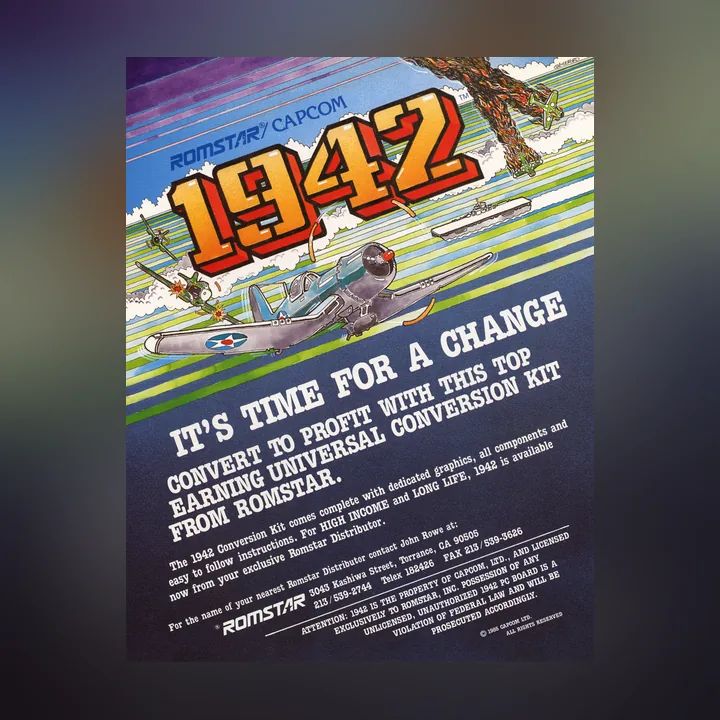
1942
1984 · Capcom · Shooter · 1–2 players
ArcadeNintendo NES
Capcom’s first entry in the long-running 194X series puts you in a twin-boomed P-38 against wave after wave of enemy aircraft – and gives you a limited supply of evasive loops to get out of trouble.
The original 1984 Arcade game and the 1985 Nintendo NES version, free to play in your browser.
Runs in your browser, fullscreen. Keyboard, gamepad and touch controls. Your progress is saved on this device.
About 1942
A vertical shooter built around one clever escape move
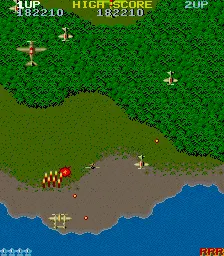
1942 scrolls upward over open sea and islands while squadrons of fighters and bombers swoop in from every edge of the screen. You pilot a P-38 Lightning nicknamed the “Super Ace”, and your only weapon is a forward-firing gun that can be upgraded along the way.
What set the game apart in 1984 was the roll. Press the dedicated button and your plane performs a loop that lifts it out of the action for a moment, so bullets and collisions pass harmlessly underneath. The number of rolls is limited, and any you still have at the end of a stage are rewarded with bonus points, so every loop becomes a small risk-versus-reward decision.
The campaign is long: 32 stages, numbered in reverse so that the game opens at stage 32 and counts down to stage 1. Each stage ends with the Super Ace landing on an aircraft carrier, followed by a bonus based on the percentage of enemy planes you managed to shoot down – the bonus is biggest when you hit 100%.
POW icons, wingmen and the big bombers
Destroy an entire formation of red planes and a POW icon drops. Depending on the icon, it doubles your guns, wipes every enemy plane off the screen, or brings in two small escort fighters that fly beside you and add their own firepower. The escorts make the P-38 a much wider target, but the extra shots are worth it against the heavier waves.
Large bombers appear as boss-style encounters that soak up a lot of bullets before going down. Staying near the bottom of the screen and saving a roll for the moment a bomber’s spread of shots reaches you is the classic way to survive them.
From Okamoto’s arcade cabinet to the Famicom
1942 was directed and designed by Yoshiki Okamoto, who later became one of Capcom’s best-known producers. Tamio Nakazato handled the programming and Ayako Mori wrote the music. Capcom released the arcade game in Japan in December 1984; in North America it was distributed by Williams Electronics and Romstar, arriving in mid-1985.
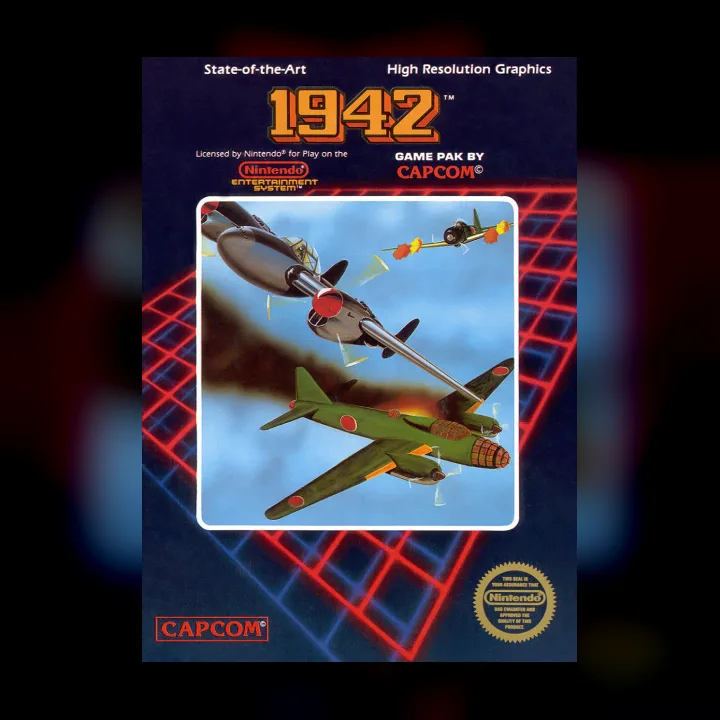
The NES version was developed by Micronics and published by Capcom. It came out on the Famicom in Japan on 11 December 1985 and reached North American NES owners in November 1986. Like many early 8-bit conversions it simplifies the arcade visuals and sound, but it keeps the structure of stages, POW pickups and limited rolls. The NES version went on to sell more than a million copies worldwide.
Which version should you pick?
This page hosts both the arcade original and the NES port. The arcade game is the reference version: sharper sprites, more aircraft on screen and Ayako Mori’s original sound. The NES cartridge is the one to pick if you grew up with it or want to see how Capcom squeezed the game onto an 8-bit console. Both support two players taking turns, so a friend can wait for the next life rather than share the screen.
Whichever you choose, the controls on our site are the original ones: one button fires, the other triggers the roll. You can play 1942 online with a keyboard, a gamepad or touch controls.
The 194X series that followed
1942 launched a family of World War II shooters. 1943: The Battle of Midway followed in 1987, then 1943 Kai, 1941: Counter Attack in 1990, 19XX: The War Against Destiny in 1996 and 1944: The Loop Master in 2000. A modern remake, 1942: Joint Strike, appeared in 2008.
Sources: en.wikipedia.org, arcade-history.com, shmup.fandom.com, arcadeheroes.com, wiki.arcadeotaku.com
Versions
1942 is here in 2 versions. Each one plays in its own emulator.
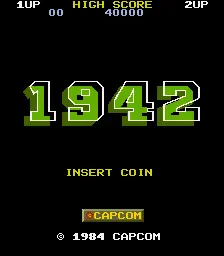
Screenshots
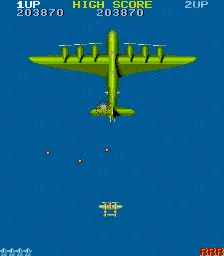
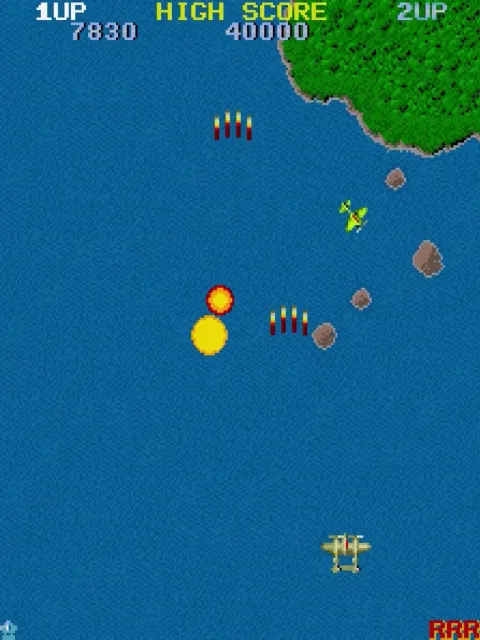
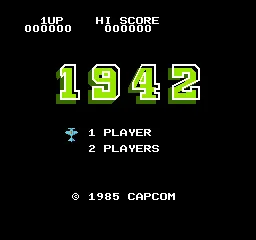
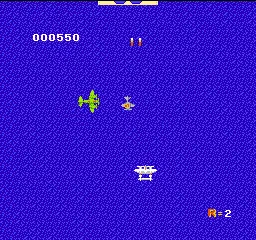
Game details
- Platforms
- Arcade, Nintendo NES
- Released
- 1984 (Arcade), 1985 (Nintendo NES)
- Developer
- Capcom (Arcade), Micronics (Nintendo NES)
- Publisher
- Capcom
- Genre
- Shooter
- Players
- 1–2 players
- Arcade release (Japan)
- December 1984
- Arcade release (North America)
- June 1985, distributed by Williams Electronics and Romstar
- Director / designer
- Yoshiki Okamoto
- Music
- Ayako Mori
- NES port developer
- Micronics
- Famicom release (Japan)
- 11 December 1985
- NES release (North America)
- November 1986
- Stages
- 32, counted down from stage 32 to stage 1
- Series
- First game in Capcom’s 194X series
- Emulators
- FinalBurn Neo (Arcade), FCEUmm (Nintendo NES)
How to play 1942
Press Play on the version you want: the game starts fullscreen in your browser, nothing to install. Press Esc or the ‹ Menu button to come back here; your progress is saved and you can continue next time.
Keyboard – Arcade
| Arrow keys | Move |
|---|---|
| V | Insert coin |
| Enter | Start |
| X, Z, S, A | Buttons 1–4 |
| Q / E | Buttons 5 / 6 |
Keyboard – Nintendo NES
| Arrow keys | Move |
|---|---|
| Z | A button |
| X | B button |
| Enter | Start |
| V | Select |
Gamepads (Xbox, PlayStation, Switch and most USB or Bluetooth pads) work as soon as you press a button; two pads give two players. On phones and tablets on-screen buttons appear. Keys can be changed in the emulator's Controls menu.
1942 FAQ
Can I play 1942 online?
Yes – pick either the 1984 arcade board or the NES cartridge on this page and it starts in your browser at no cost. Fire and roll can be used from a keyboard, a gamepad or on-screen touch buttons, and progress stays saved on this device.
How many stages does 1942 have?
There are 32 stages. They are numbered backwards, so you start at stage 32 and the final stage is stage 1.
How does the loop (roll) work in 1942?
Pressing the roll button makes your P-38 loop out of harm’s way for a moment, avoiding enemy fire and collisions. Rolls are limited, and unused ones earn bonus points at the end of the stage.
Is 1942 a two-player game?
Yes, both versions on this page let two players take part, alternating turns rather than flying side by side.
Who made 1942?
Capcom developed the arcade game, directed by Yoshiki Okamoto. The NES conversion was developed by Micronics and published by Capcom.
Comments
No comments yet. Be the first!