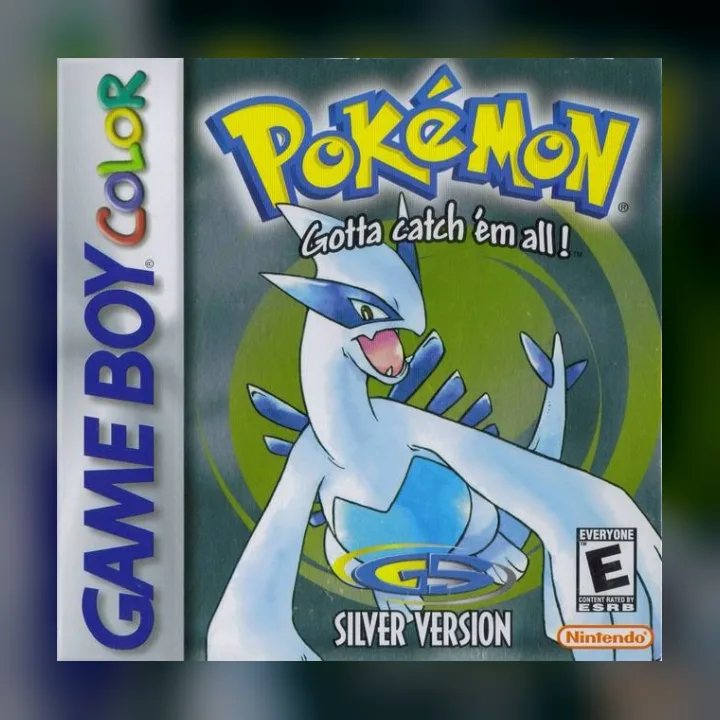
Pokémon Silver Version
2000 · Nintendo · Adventure, Role-Playing · 1–2 players
Nintendo Game Boy Color
Pokémon Silver is the Lugia half of the Game Boy Color pair that took the series to Johto. It shares Gold’s story but has its own wild Pokémon and the sea legendary on its box. This page runs the English USA/Europe cartridge.
The 2000 Nintendo Game Boy Color game, free to play in your browser.
Runs in your browser, fullscreen. Keyboard, gamepad and touch controls. Your progress is saved on this device.
About Pokémon Silver Version
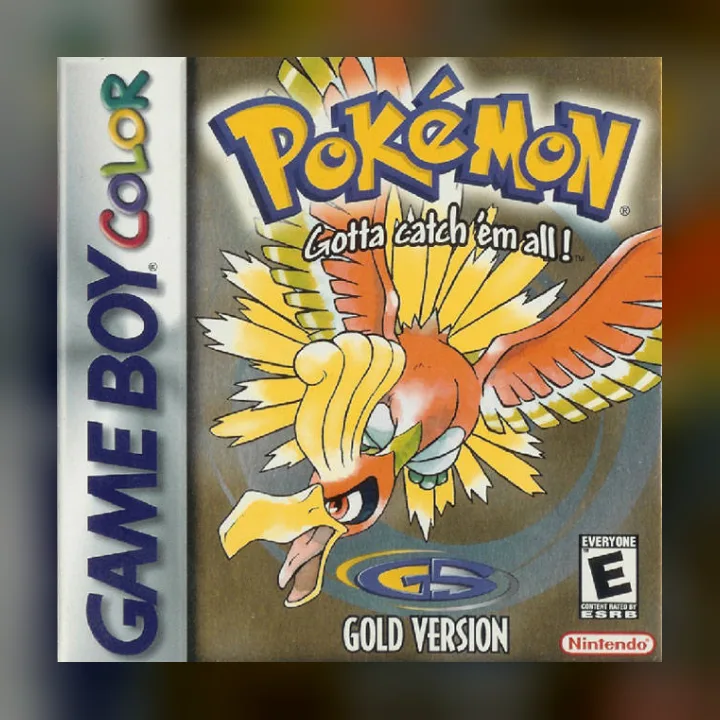
Lugia, the legend on the box
Silver puts Lugia front and centre. In this version, beating Team Rocket in Goldenrod City earns you the Silver Wing, the item that lets you reach Lugia in the depths of the Whirl Islands. Here it is level 40 and is the only Lugia in Gold or Silver that knows its signature move, Aeroblast. Ho-Oh is not missing, but it is a late-game prize: an old man in Pewter City, over in Kanto, gives you the Rainbow Wing, and the bird waits at the top of Tin Tower at level 70.
Nintendo leaned on Lugia when it marketed the games in North America, even fitting out five PT Cruisers in its style. Lugia and Ho-Oh were among the English names revealed before launch, so fans knew the two legends long before they could catch them.
What Silver has that Gold does not
Ten Pokémon appear in the wild in the English Silver and not in Gold: Vulpix and Ninetales, Meowth and Persian, Ledyba and Ledian, Delibird, Skarmory, and Phanpy with its evolution Donphan. In return, Silver players cannot find Gold’s Mankey, Growlithe, Spinarak, Gligar, Teddiursa or Mantine lines without a trade. In the Japanese releases some of these exclusives sat in the opposite version.
The split shapes your team. Skarmory, part of the new Steel type, is a sturdy flyer that Gold owners can only get from a Silver player, and Phanpy grows into the heavy Ground-type Donphan. Silver also proved slightly more popular at home: by April 2000 it had sold around 100,000 more copies than Gold in Japan.
Three and a half years in the making
Gold and Silver were first shown at Nintendo Space World in November 1997, where they drew the biggest crowds, and were meant to come out in 1998. They did not. Game Freak was also busy with Pokémon Stadium and with bringing the first games to other countries, and Pokémon Yellow filled the gap. In the end development took about three and a half years with a team of roughly four programmers.
Help came from outside Game Freak. Satoru Iwata, then president of HAL Laboratory, studied the code of the original games and, at the request of programmer Shigeki Morimoto, built tools to compress the Pokémon graphics data. Junichi Masuda wrote his music on an Amiga computer, converting it to MIDI and then again for the Game Boy Color.
In 2018 ROMs of the 1997 Space World demo leaked online. They showed a larger world map and about 100 Pokémon designs that were later changed or dropped.
Legacy and how to play here
The wait paid off. Gold and Silver sold 1.4 million copies in their first week in the United States and 23 million worldwide, and critics averaged 91 percent for Silver on GameRankings. Pokémon Crystal followed in December 2000, the DS remakes HeartGold and SoulSilver arrived in 2009 in Japan and 2010 elsewhere, and both originals returned on the Nintendo 3DS Virtual Console on 22 September 2017.
Use the D-pad to move, A to talk and confirm, B to cancel and Start to open the menu and save. Your progress is stored in this browser.
Sources: en.wikipedia.org, serebii.net, iwataasks.nintendo.com
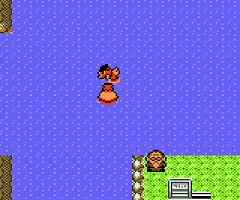
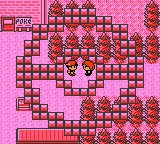
Screenshots
Game details
- Platform
- Nintendo Game Boy Color
- Released
- 2000
- Developer
- Game Freak
- Publisher
- Nintendo
- Genre
- Adventure, Role-Playing
- Players
- 1–2 players
- Japan release
- 21 November 1999 (alongside Gold)
- North America release
- 15 October 2000
- Europe release
- 6 April 2001
- Developer / Publisher
- Game Freak / Nintendo
- Programmer
- Shigeki Morimoto
- Artist
- Ken Sugimori
- Box legendary
- Lugia (level 40 in Silver)
- Exclusive Pokémon
- 10 (Vulpix, Meowth and Ledyba lines, Delibird, Skarmory, Phanpy line)
- Nintendo 3DS Virtual Console
- 22 September 2017
- Version on this page
- USA/Europe Game Boy Color cartridge (English)
- Emulator
- Gambatte
How to play Pokémon Silver Version
Press Play: the game starts fullscreen in your browser, nothing to install. Press Esc or the ‹ Menu button to come back here; your progress is saved and you can continue next time.
Keyboard
| Arrow keys | Move |
|---|---|
| Z | A button |
| X | B button |
| Enter | Start |
| V | Select |
Gamepads (Xbox, PlayStation, Switch and most USB or Bluetooth pads) work as soon as you press a button; two pads give two players. On phones and tablets on-screen buttons appear. Keys can be changed in the emulator's Controls menu.
Pokémon Silver Version FAQ
Can I play Pokémon Silver online for free?
Yes. This page runs the USA/Europe Game Boy Color cartridge in your browser at no cost, with keyboard, gamepad or touch controls. Your save is kept in your browser.
What is the difference between Pokémon Gold and Silver?
The story is the same. The versions differ in their ten exclusive wild Pokémon and in which legendary is easy to get: Silver has Lugia at level 40, Gold has Ho-Oh at level 40.
Where is Lugia in Pokémon Silver?
In the Whirl Islands. You need the Silver Wing, which you receive after defeating Team Rocket in Goldenrod City.
Can I catch Ho-Oh in Silver?
Yes, after the main story. An old man in Pewter City gives you the Rainbow Wing, and Ho-Oh waits at level 70 at the top of Tin Tower.
Can I trade with Gold on this page?
No. Trading needs two linked games, and this emulator runs a single game in one browser, so Gold’s exclusives cannot be traded in here.
Comments
No comments yet. Be the first!